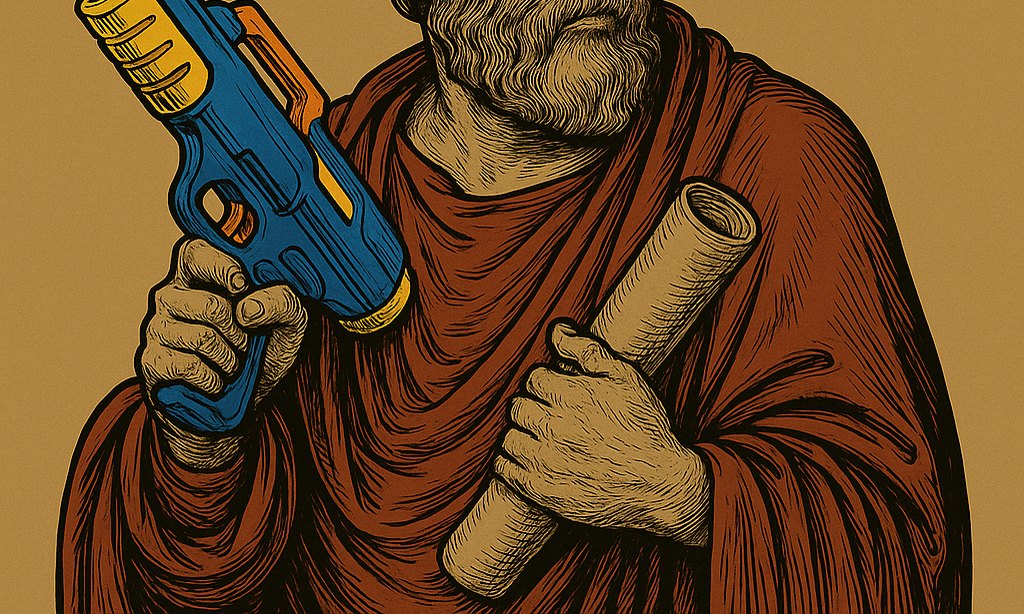
The book closes with this letter, written in the form and cadence of Paul’s own epistles. It is rhetorical satire, a mirror held up to Paul, and it is written as fiction.1
To the congregations of Paul
I, a servant set free from the shadow of Paul, who once walked in the darkness of a false revelation and now return to the pure teaching, write to you who still hold fast to the gospels that were turned aside: grace and peace to you from the Most High, and from ʿĪsā al-Masīḥ, His honored servant.
I give thanks to the Most High, who in His kindness has opened the eyes of some of His servants from a belief inherited without understanding. So I write with the ink of love, born of the light of truth that has touched the heart.
You have heard how I once defended Paul with all my zeal, reading aloud all his letters and guarding him from every reproach. Yet when I was tried by evidence and light, it became plain to me that the gospel I defended was another gospel.2 It came from the tongue of a man who claimed to have seen a light on the road, with no witness and no confirmation from the congregation, and who then named himself an apostle of Christ Jesus.3
Have you forgotten that Paul never met ʿĪsā al-Masīḥ? That he never sat to hear his words? And do you not know that the disciples in Jerusalem kept their distance from his teaching, and that Barnabas himself parted from his way?
How then have you turned so quickly from the teaching of ʿĪsā al-Masīḥ, who never claimed divinity for himself,4 to a man who made him a god on weak proofs and false words?
Test every spirit. Weigh every word and examine every claim.
Be not deceived by speech that glitters and misleads, for even the adversary disguises himself as an angel of light.5 Is it not the one in disguise who comes bearing a gospel of Christ Jesus that heaven never confirmed?
Do you not know that the story he told of Damascus contradicts itself?6
What then is this, revelation or invention? If it came from heaven, would its course not be steady? If it came from the Most High, would it not speak with one voice?
I bear witness with all my soul and understanding that a gospel which sets aside the law and raises ʿĪsā al-Masīḥ to be God is no gospel from heaven. If ʿĪsā al-Masīḥ himself said, “I am not come to destroy, but to fulfil,”7 how then does Paul say, “ye are not under the law”?8 Do two voices come from one God, or has a quarrel arisen among those who wrote them down?
My brothers and sisters, I say this to wake you, and with no wish to bring you down. Have you examined whom you follow?
If ʿĪsā al-Masīḥ never taught his own divinity and yet you worship him, who has turned your worship aside? Do you not fear that you will stand one day before the Most High and learn that the one you followed was never sent, though he called himself a servant of Christ Jesus?
I write with tears: leave Paul, and return to the true teaching of ʿĪsā al-Masīḥ. Follow him as a servant of the Most High, in the station he himself claimed. Worship Him alone who is One, and none whom the words and inventions of men have made divine.
Greet all who seek the truth in the real ʿĪsā al-Masīḥ. Hold fast to the oneness of God, and keep away from the gospel of one who repeated the name of Christ Jesus as a shield for his error, a gospel that heaven never sent.9
This I have written with my own hand, as a sign that I no longer live in the shadow of Paul.10
May the grace of the Most High, who sent ʿĪsā al-Masīḥ as His servant, be with you who seek the truth. And may you be freed from that shadow and return to the teaching of the true messenger.
Amen.
From one who once walked in the shadow of Paul, and has now turned to ʿĪsā al-Masīḥ, ʿalayhi al-salām, servant of the true Lord.
- The letter also offers a metalinguistic critique of the phrase “Christ Jesus,” which Paul uses to separate a theological figure from the historical ʿĪsā al-Masīḥ, following the analysis of Isma’il R. al Faruqi. In the Malay original, God is addressed by the classical title Dewata Mulia Raya, drawn from the Terengganu Inscription Stone (1303); this translation renders it as “the Most High.” ↩
- cf. Galatians 1:6–9, where Paul warns against “another gospel,” an irony given that he fashioned one himself. ↩
- “Christ Jesus” (Χριστὸς Ἰησοῦς) is Paul’s characteristic form, where the Gospels usually have “Jesus Christ.” It puts the messianic title ahead of the historical person. See Philippians 1:1. ↩
- Mark 10:18; John 17:3. ↩
- 2 Corinthians 11:14. ↩
- Acts 9:3–7, 22:6–9, 26:12–18. ↩
- Matthew 5:17–19. ↩
- Romans 6:14 (KJV). ↩
- cf. Galatians 1:11–12, where Paul claims to have received his gospel by revelation and from no man, without witness or proof of apostleship. ↩
- An echo of Paul’s own closing in Galatians 6:11: “Ye see how large a letter I have written unto you with mine own hand.” ↩