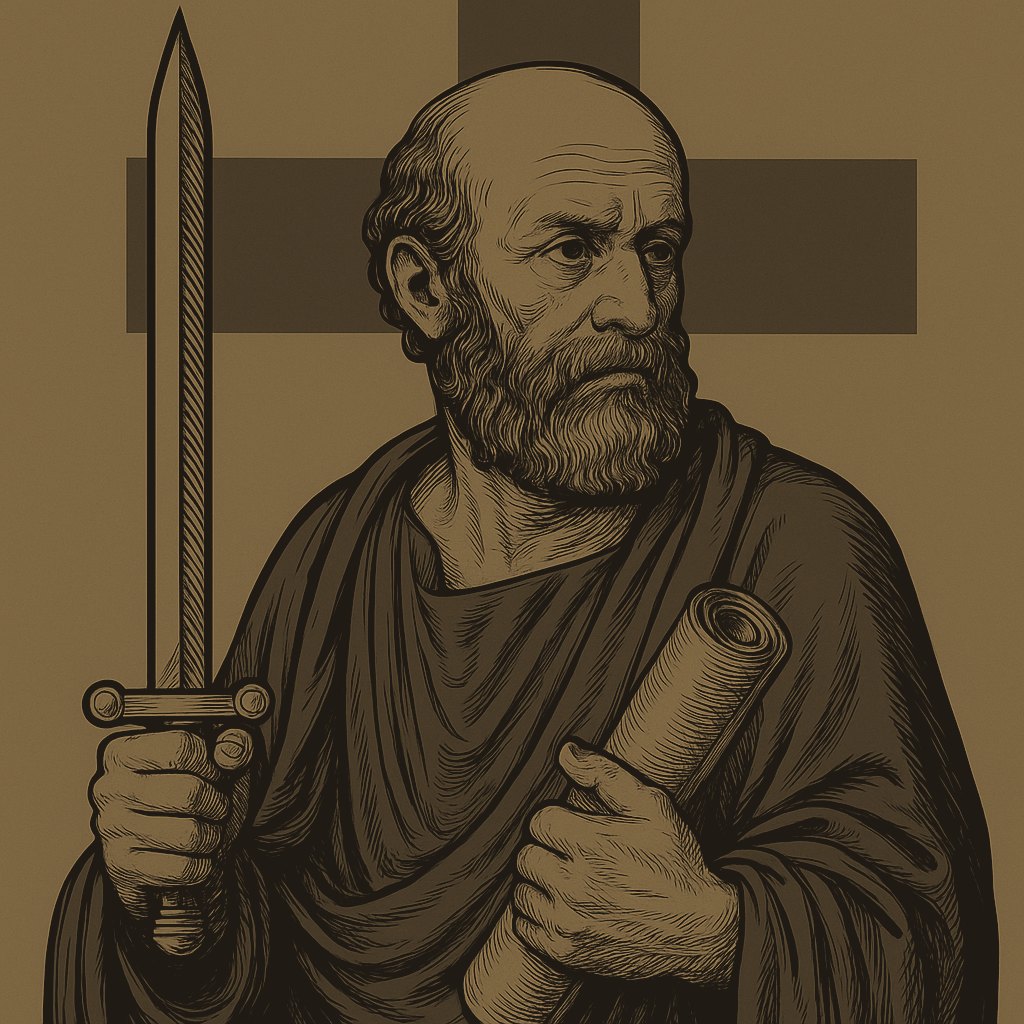
Having examined Paul’s life and teaching from the standpoint of doctrine and social relations, we come to a dimension rarely discussed and yet decisive: his personality. Is there a psychological factor that explains the radical shift from persecutor to creator of a new theology? These articles trace Paul’s personality through his inner experience, the oddities of his narrative, and the psychiatric implications that may lie hidden behind the rhetoric of apostleship he claimed for himself.
The terrorist from Tarsus, who once hunted and oppressed the followers of ʿĪsā ibn Maryam (ʿalayhi al-salām, peace be upon him), ended as the figure who worked hardest to distort that same teaching, creating a system of belief wholly at odds with the message of the prophets. His emergence as an “apostle” was never confirmed by the early community of al-Masīḥ.
It rested on a private inner experience witnessed by no one, an event that became the basis of the whole new theological framework he introduced. So drastic a shift, from oppressor to builder of doctrine, deserves examination from the standpoint of psychology as well as history, above all as a serious case of psychogenic dissociation.2
A portrait of this kind is interpretation. It cannot replace the theological and historical case against Paul, and it is meant to be read beside it.
An unresolved identity
In developmental psychology, Paul’s experience can be understood through the Eriksonian frame of identity, above all the unresolved identity crisis of early adulthood.3 His sudden conversion, from oppressor to evangelist, was more than a spiritual transformation. It was psychological compensation for a void of selfhood that had failed to form within his original frame.
The choice of a radical theological path can be read as a narrative of self-repair built after moral and social trauma. In the narrative terms of McAdams, Paul formed a personal myth that justified deviation as a sacred mission, and made his experience at Damascus the starting point of a narrative of self-“redemption.”4
Beyond the personal myth, Paul shows a defective generativity script, the concept McAdams proposed to explain how individuals try to give meaning to life by “bequeathing” values or systems to the next generation.5 In Paul’s case the “legacy” was an alternative system that denied the theological foundation of al-Masīḥ. His life scheme was driven by the urge to redeem the past through a new creation that substitutes, and no legitimate regeneration.
From the standpoint of intersubjectivity, his spiritual experience was validated only in the light of a fantasy of his own making: his psychological reality became the structure of his theological truth.6 Here psychobiography shows its strength: it uncovers how narrative, trauma and desire shape dogma. An understanding of Paul’s “apostleship” cannot rest on the content of his teaching alone; it demands a reading of the inner space that formed it.
Guilt and its disguises
The hallucinatory experience Paul describes, a blinding light, a bodiless voice, temporary blindness, can be read within the frame of psychological disorder as a manifestation of deep inner pressure and moral trauma.7 According to DSM-5, symptoms of this kind match Dissociative Identity Disorder or delusional disorder with religious content,8 which involve a splitting of identity and a distorted interpretation of reality under pressure or inner conflict. Freud saw such symptoms as the product of tension between repressed drives and the demands of a harsh superego.9
In Paul’s case the transcendent experience can be read as sublimation: a diversion of libidinal energy from the guilt of killing the followers of al-Masīḥ into a “holy calling.”10 The conversion, qua psychological event, reads as psychic compensation to cancel a past moral trauma; qua theological claim, it remains unverifiable. That reading matches Gerd Lüdemann’s view of Paul as a man “torn by torments of the soul,” “confused by the conflict between conviction, desire and conduct,” who made the projected voice of his superego the voice of God himself.11
Freud also explains that guilt not consciously acknowledged often leads to reaction formation, in which the individual displays behavior wholly opposed to the original drive.12 Paul, once a persecutor of the followers of ʿĪsā ibn Maryam, became their most fanatical preacher, through an inability to accept his own dark side. By rejecting the law of the Torah entirely and forming a radical system of belief different from the common understanding, he indirectly denied his old identity as a Pharisee, a classic form of self-rejection.
Hatred without cause
This psychological manifestation did not appear in a vacuum. It borrowed its form from the pattern of religious hatred already present in his collective tradition.
As noted earlier, Paul’s extreme hatred of the ḥawāriyyūn (الحواريون, “the disciples”) and the followers of ʿĪsā ibn Maryam cannot be explained by history or religious polemic alone. It reflects an ideological hatred resembling what the Jewish rabbis call sinat chinam (שִׂנְאַת חִנָּם), hatred without reasonable or rational cause.
The Babylonian Talmud states that although the generation of the Second Temple was active in the study of the Torah, the performance of the commandments and social welfare, the Temple was destroyed because such hatred had taken root in their society.13 That is more than personal hatred: it is a theological hostility that justifies violence in the name of piety. In Paul’s case the hatred sprang from an unresolved identity crisis and inner pressure, and was channeled through cruelty.
The instability shows literally in his own writing:
8For though I made you sorry with a letter, I do not repent, though I did repent: for I perceive that the same epistle hath made you sorry, though it were but for a season.1
The verse is no ordinary expression. It reflects an inner confusion: Paul wants to assert his firmness, yet cannot hide his reluctance over the emotional effect of his own action. The failure to be consistent in expressing intention and emotion matches the profile of an individual under disorganized psychological pressure, in which the rational process is disturbed by conflicting inner eruptions.
So it is more than his unseen manifestation at Damascus that should be doubted. The whole structure of his mind, as the originator of this new doctrine, calls for closer examination from the side of psychopathology.
- 2 Corinthians 7:8 (KJV). ↩
- D. Landsborough, “St Paul and Temporal Lobe Epilepsy,” Journal of Neurology, Neurosurgery, and Psychiatry, vol. 50, no. 5 (1987), pp. 659–664. ↩
- Erik H. Erikson, Identity: Youth and Crisis (New York: W. W. Norton, 1968), pp. 128–135. ↩
- Dan P. McAdams, The Stories We Live By: Personal Myths and the Making of the Self (New York: The Guilford Press, 1993), pp. 11–19. ↩
- Dan P. McAdams, The Redemptive Self: Stories Americans Live By, 2nd ed. (New York: Oxford University Press, 2013), pp. 94–97. ↩
- Robert D. Stolorow and George E. Atwood, Faces in a Cloud: Intersubjective Sources of Psychological Theories, 2nd ed. (Lanham, MD: Rowman & Littlefield, 2002), pp. 67–70. ↩
- ibid. ↩
- Diagnostic and Statistical Manual of Mental Disorders (DSM-5), 5th ed. (Washington, DC: American Psychiatric Publishing, 2013), pp. 90–93, 291–294; compare the International Classification of Diseases (ICD-11): 6D11.3, 6D11.0, 6A24.0. ↩
- The superego is the structure of the psyche that, in Freud, functions as conscience or inner judge of the individual’s conduct. See Sigmund Freud, The Future of an Illusion, trans. James Strachey (New York: Norton, 1961), pp. 54–56. ↩
- ibid. ↩
- Gerd Lüdemann, Paul: The Founder of Christianity (Amherst, New York: Prometheus Books, 2001), p. 244. Quoted as rendered in the Malay edition of the book. ↩
- op. cit. ↩
- For further discussion of sinat chinam, see the Babylonian Talmud, Yoma 9b: “But the Second Temple, in whose time they occupied themselves with Torah, the commandments and acts of kindness, why was it destroyed? Because there was baseless hatred in it.” The moral weight of the concept is set out by Jonathan Sacks and Doron Perez (see the earlier article on Saul the persecutor). ↩