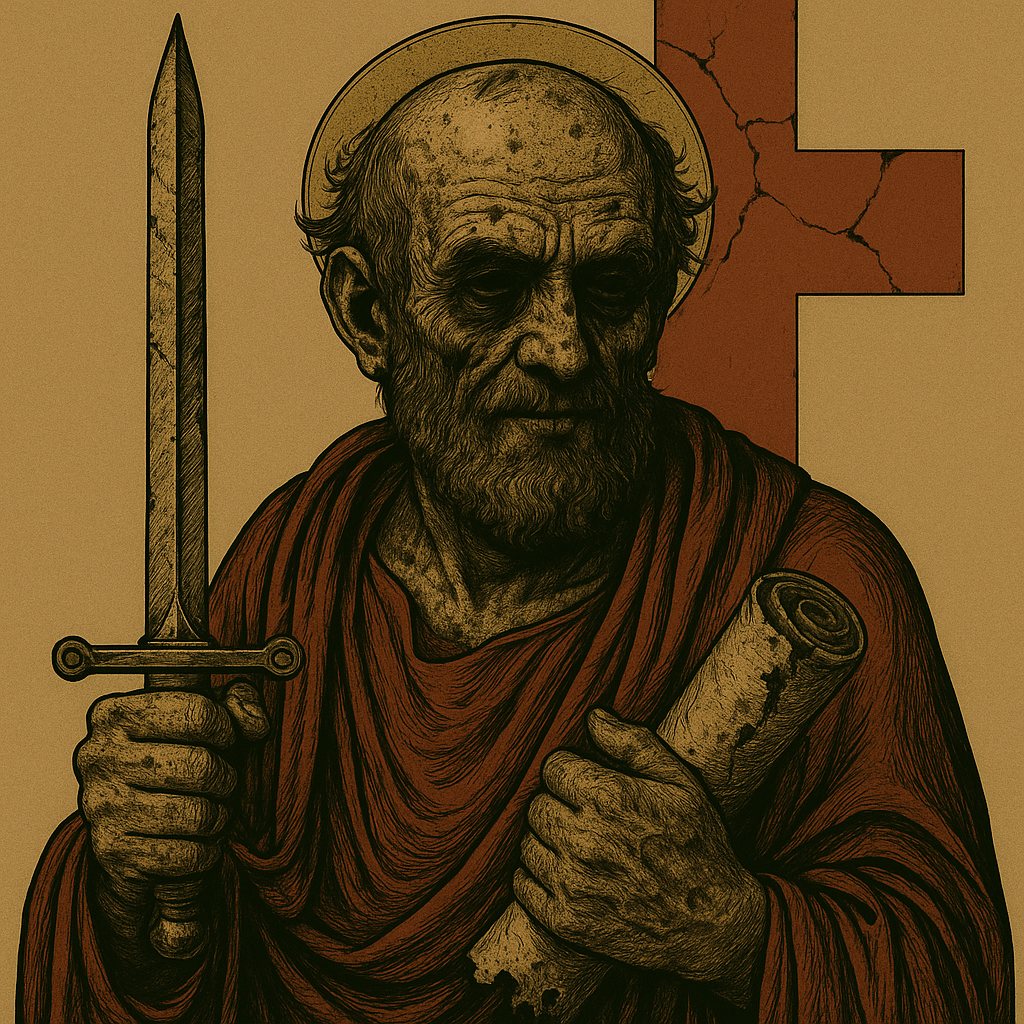
The story of Paul’s repentance exists in several versions, all drawn from a single main narrative, the Acts of the Apostles in the New Testament.
Here is the first version of what Paul experienced, as Acts tells it:
3And as he journeyed, he came near Damascus: and suddenly there shined round about him a light from heaven: 4And he fell to the earth, and heard a voice saying unto him, Saul, Saul, why persecutest thou me? 5And he said, Who art thou, Lord? And the Lord said, I am Jesus whom thou persecutest: it is hard for thee to kick against the pricks. 6And he trembling and astonished said, Lord, what wilt thou have me to do? And the Lord said unto him, Arise, and go into the city, and it shall be told thee what thou must do. 7And the men which journeyed with him stood speechless, hearing a voice, but seeing no man. 8And Saul arose from the earth; and when his eyes were opened, he saw no man: but they led him by the hand, and brought him into Damascus. 9And he was three days without sight, and neither did eat nor drink.1
Here is the second version of the same event. Like the first, it is recorded in Acts, but with somewhat different details:
6And it came to pass, that, as I made my journey, and was come nigh unto Damascus about noon, suddenly there shone from heaven a great light round about me. 7And I fell unto the ground, and heard a voice saying unto me, Saul, Saul, why persecutest thou me? 8And I answered, Who art thou, Lord? And he said unto me, I am Jesus of Nazareth, whom thou persecutest. 9And they that were with me saw indeed the light, and were afraid; but they heard not the voice of him that spake to me. 10And I said, What shall I do, Lord? And the Lord said unto me, Arise, and go into Damascus; and there it shall be told thee of all things which are appointed for thee to do. 11And when I could not see for the glory of that light, being led by the hand of them that were with me, I came into Damascus.2
And here is the third, Paul’s retelling of his experience before King Agrippa, longer than the other two and different from both:
12Whereupon as I went to Damascus with authority and commission from the chief priests, 13At midday, O king, I saw in the way a light from heaven, above the brightness of the sun, shining round about me and them which journeyed with me. 14And when we were all fallen to the earth, I heard a voice speaking unto me, and saying in the Hebrew tongue, Saul, Saul, why persecutest thou me? it is hard for thee to kick against the pricks. 15And I said, Who art thou, Lord? And he said, I am Jesus whom thou persecutest. 16But rise, and stand upon thy feet: for I have appeared unto thee for this purpose, to make thee a minister and a witness both of these things which thou hast seen, and of those things in the which I will appear unto thee; 17Delivering thee from the people, and from the Gentiles, unto whom now I send thee, 18To open their eyes, and to turn them from darkness to light, and from the power of Satan unto God, that they may receive forgiveness of sins, and inheritance among them which are sanctified by faith that is in me.3
Which of these is the true account of the event?
The three versions compared
| Detail | Version 1 (Acts 9:3–9) | Version 2 (Acts 22:6–11) | Version 3 (Acts 26:12–18) |
|---|---|---|---|
| Time of day | Not stated (“as he journeyed”) | About noon | At midday |
| Source of light | A light from heaven | A great light from heaven | A light from heaven, above the brightness of the sun |
| Who fell to the ground | Paul alone | Paul alone | All of them |
| What the companions perceived | Heard a voice but saw no man | Saw the light but heard not the voice | Not stated |
| Language of the voice | Not stated | Not stated | Hebrew |
| Identity of the voice | “I am Jesus” | “I am Jesus of Nazareth” | “I am Jesus,” with a mandate of apostleship added |
| Further dialogue | Only told to go into the city | Paul asks, “What shall I do, Lord?” | Long and complete, including the apostolic mission |
| The commission | To be told in the city | To be told in the city | Given on the spot: to preach to the Gentiles |
| Paul’s sight afterward | Blind for three days | Could not see for the glory of the light | No blindness mentioned |
The three versions give different pictures of what is supposed to be one event: how many fell, whether the voice was heard, the detail of the dialogue. The differences raise questions about the reliability of the telling, and about the possibility of addition or reworking by Paul, above all in the third version delivered before King Agrippa. They have long been debated by historians of Christianity and scholars of the biblical text.
Some Christians defend the contradiction by arguing that the Greek histēmi (ἵστημι), translated “stood,” need not mean standing physically and could mean “fixed” or “in place,” so that there is no conflict with the statement that all fell to the ground.4 An explanation of that kind is too technical to persuade, because it does not arise from a natural reading of the text. The claim that Paul’s companions had time to get up again before the dialogue is a supposition supported by no detail in the narrative.5
Interpretations that try to harmonize the contradiction are ad hoc: they depend on possible meanings of a word or on the timing of events, and that dependence exposes the weakness of the narrative. If the story had happened and been transmitted consistently, it would need no elaborate reinterpretation to explain basic conflicts over who fell and who heard the voice.6
Possibility cancels proof
Paul plainly reshaped his story to convince King Agrippa, and in that he succeeded. In the science of logic (manṭiq), any proof that carries an element of possibility or doubt is unfit to serve as valid evidence, on the principle al-iḥtimāl yusqiṭ al-istidlāl (الاحتمال يسقط الاستدلال, “possibility cancels the proof”). When a piece of evidence admits another meaning, and is not the only certain explanation, the argument falls as a valid basis for a conclusion.
The three conflicting versions of the Damascus story cannot be reconciled naturally without forced interpretation. A narrative this vague and changeable raises deep logical doubt, and on the principle above it should be rejected. The inference from a private vision to a public office is, ex hypothesi, unsecured: the premise admits three versions and the conclusion admits none.
It is unfit to ground Paul’s “apostleship”, still less to become doctrine in a religion. A confused and contradictory story ought to produce suspicion, not certainty.
A borrowed narrative form
The narrative style attached to Paul’s experience, above all the Damascus episode, shows features that resemble the accounts of commissioning or mystical experience common in Graeco-Roman tales and epics. The light from the sky, the disembodied voice and the dramatic apostolic appointment echo the structure of the hero’s quest or the chosen figure in classical literature such as Virgil’s Aeneid.
These features raise the question whether the experience was authentic revelation or a deliberate construction imitating a religious narrative form familiar to the Mediterranean world. They strengthen the case that Paul built his apostolic image through literary adaptation.7
A Yale scholar’s verdict
Some modern Christian scholars have criticized the Damascus event that is claimed as the basis of Paul’s “apostleship”. Dale B. Martin, a New Testament scholar at Yale, questioned the historical reliability of the Acts narrative when set against Paul’s own letters:
Acts portrays Paul’s visionary experience more as a conversion to “the Way” than a call to apostleship. But that is not how Paul saw it. In the one place we hear Paul’s own description of his experience, Paul speaks of it not as a “conversion”… Rather, he uses images and language like the descriptions of the calling of a prophet in the Old Testament.8
He adds:
A firsthand account written a few years after the event must be historically preferable to one written decades later by someone not present.9
That finding agrees with a further observation: the whole narrative of a bright light from heaven and a voice from nowhere is found only in Acts. It appears in none of the letters attributed directly to Paul.
The absence raises a serious question about the authenticity of the experience. Did it happen at all, or is it a rhetorical composition that serves to justify the apostleship of a man who had begun as the enemy of the teaching of ʿĪsā ibn Maryam (ʿalayhi al-salām, peace be upon him)?
- Acts 9:3–9 (KJV). ↩
- Acts 22:6–11 (KJV). ↩
- Acts 26:12–18 (KJV). ↩
- Acts 9:7. ↩
- Acts 26:14. ↩
- Acts 22:9. ↩
- Several modern scholars pursue this approach under the name “mimesis criticism,” the study of how writers imitate or adapt literary elements from earlier works for rhetorical or ideological ends. Prominent among them is Dennis R. MacDonald, The Homeric Epics and the Gospel of Mark (New Haven: Yale University Press, 2000) and Does the New Testament Imitate Homer? Four Cases from the Acts of the Apostles (New Haven: Yale University Press, 2003), who argues that New Testament narratives may have been shaped by classical Graeco-Roman epic as much as by historical experience. ↩
- Dale B. Martin, New Testament History and Literature (New Haven: Yale University Press, 2012), p. 204. The author was able to correspond personally with the late Dr. Martin in a series of closed discussions between October 2022 and March 2023 on Paul and his writings, before his sudden death in November 2023. Video recordings of those discussions remain in the author’s keeping. ↩
- ibid., p. 75. ↩