
The church has painted, carved and cast Paul for seventeen centuries, and the image it settled on is consistent from the catacombs to the Vatican. He is bald or balding, with a high forehead and a long, pointed dark beard; he holds a book and, from the high Middle Ages, a sword. The book stands for his letters, the sword for the instrument of the martyrdom the tradition assigns him.
The illustrations on this site take that image and turn it. The sword and the scroll in every portrait here are the church’s own attributes, given back to Paul with the halo cracked, the horns added and the cap lettered. This page shows the originals.
The earliest portrait #
The oldest images of Paul come from the catacombs of Rome, from the fourth century, when the church had already paired him with Peter as the founders of its Roman see. In this fresco he stands beside the enthroned Christ, the type already fixed.

The founders of Rome #
Within a generation of Constantine the pairing became a programme. In the apse of Santa Costanza, Christ stands between Peter and Paul in the scene called the Traditio Legis, the handing over of the law. The man who called the law a curse stands at the side of the one who hands it over.

The Byzantine saint #
The Greek church kept the same face and added the gold. This enamel medallion, made for the frame of an icon around 1100, names him in Greek as Ho Hagios Paulos, “Saint Paul,” and shows him with the book of his letters.

Some five centuries earlier an ivory carver in the East cut him full length. Paul stands under a shell-headed arch with a book in his hand, and his name runs along the bar above his head.

The attributes fixed #
By the sixteenth century the two attributes were fixed. In this Netherlandish panel, attributed to Lucas van Leyden, Paul stands in a white mantle with a long sword in one hand and a closed book against his chest, and a banner above him gives his name in capitals.

The same pair of attributes survives in the parish statues made for churches today. This one holds a scroll and a sword. Its photographer notes that the sword is meant to stand for “the sword of the Spirit”, the phrase in Ephesians 6:17; the tradition above reads it as the sword of his execution.

Carved for the altar #
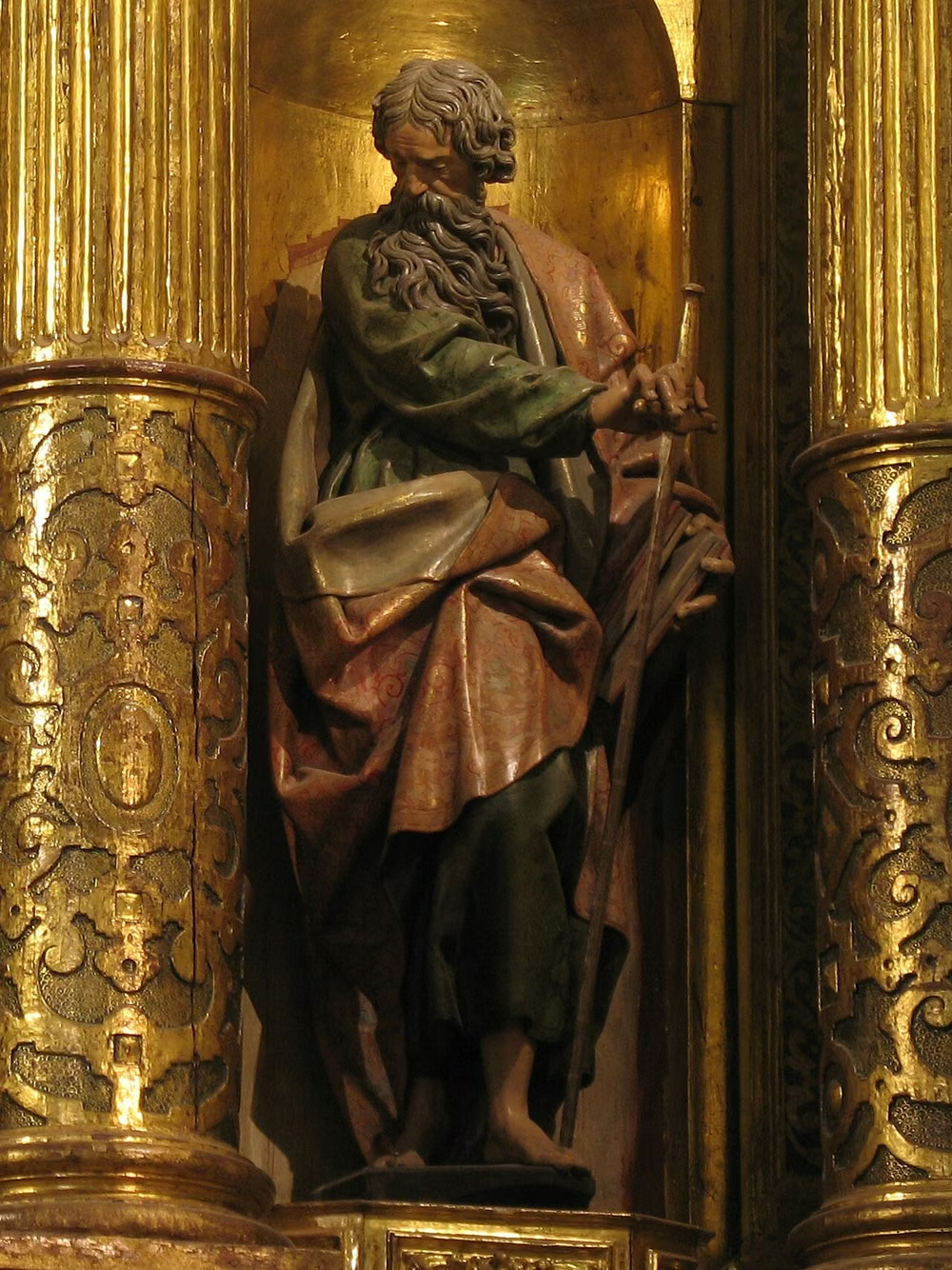
The Spanish Baroque made him in painted and gilded wood. Gregorio Fernández carved this Paul in 1606 for the high altar of a church in Valladolid, a sword in one hand and a book under the other arm, in a niche between gilded columns.
The grotto at Rabat #
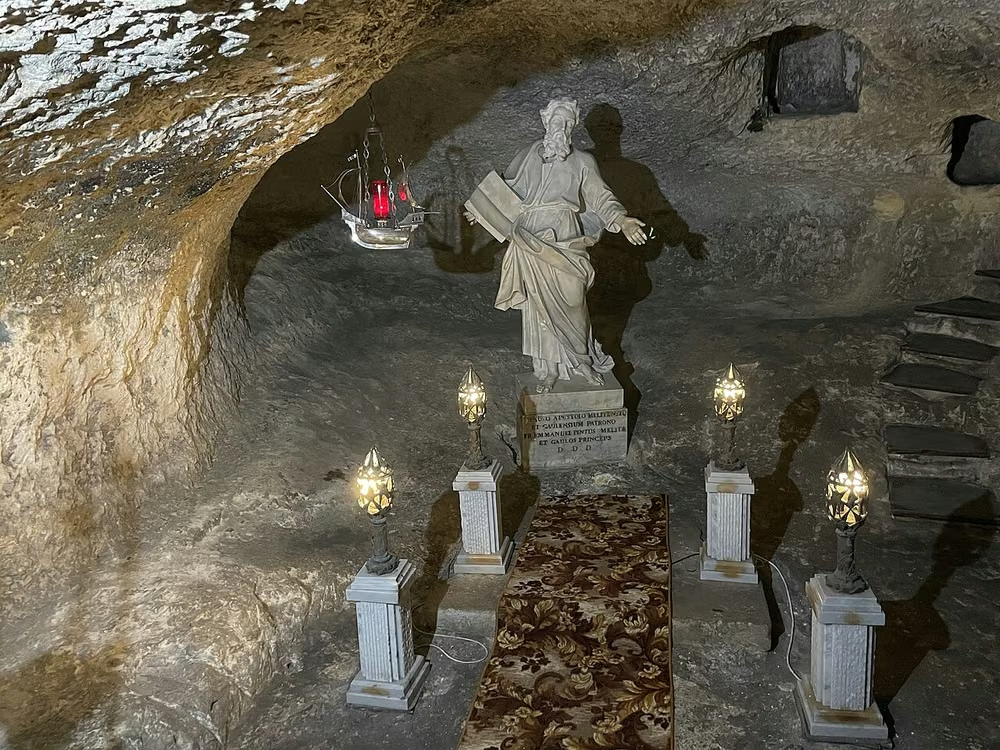
Acts tells of a shipwreck on Malta and three months spent on the island (Acts 27–28). It names no cave. Maltese tradition shows one at Rabat, beneath the church of Saint Paul, where Paul is said to have sheltered. A marble statue of him stands inside, with lamps before it.
The light on the road #
The Renaissance and the Baroque painted the conversion more than any other scene of his life. Caravaggio’s version, painted for a chapel in Santa Maria del Popolo, is the most famous; its treatment of the three accounts in Acts is discussed under The Damascus road: one vision, three stories.

The sword and the book #
Tradition had fixed the attributes long before. In Florence in 1333, Bernardo Daddi painted Paul at full length on a tall panel of gold, the sword in his right hand and the book held against his chest, with twelve small worshippers kneeling at his feet. The panel names him in gold on red, “PAU LUS”, a syllable on either side of his head, and its frame records the year the work was finished.

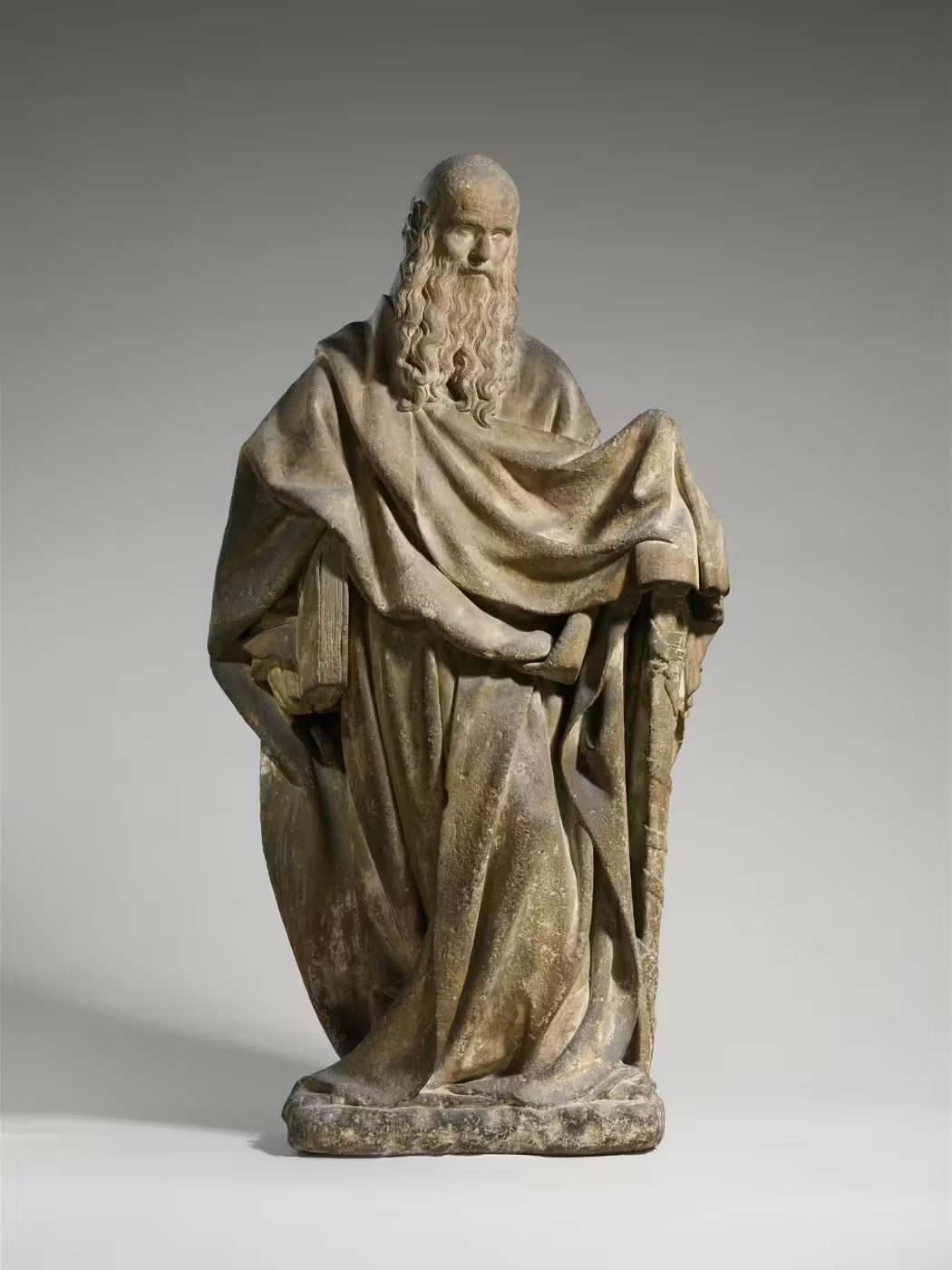
A century later a Burgundian sculptor could carve Paul by formula, bald and long-bearded, with a book for his letters and a sword for the manner of his death. The statue stood in a private chapel at Poligny, where the de Plaine family kept him as their advocate in heaven.
In the nineteenth century the papacy set a colossal Paul before Saint Peter’s, facing a Peter with his keys. Adamo Tadolini’s statue gives him both attributes at full size: the sword held downward in one hand, the book in the other.

The cult of relics #
Rome shows three sites of Paul’s death and burial, none of them recorded in scripture. The church at Tre Fontane marks the place of the beheading; the basilica on the Ostian Way keeps the sarcophagus; the Lateran keeps the head. Their evidence is examined under The failed prophet.


What the images show #
The iconography is a record of the church’s judgment on Paul. The church gave the man who never met ʿĪsā ibn Maryam ʿalayhi al-salām, peace be upon him a place beside Peter, at the gate of its chief basilica, over its high altars and in its reliquaries. The case this site sets out is that the place was usurped; the images show how completely the usurpation succeeded.