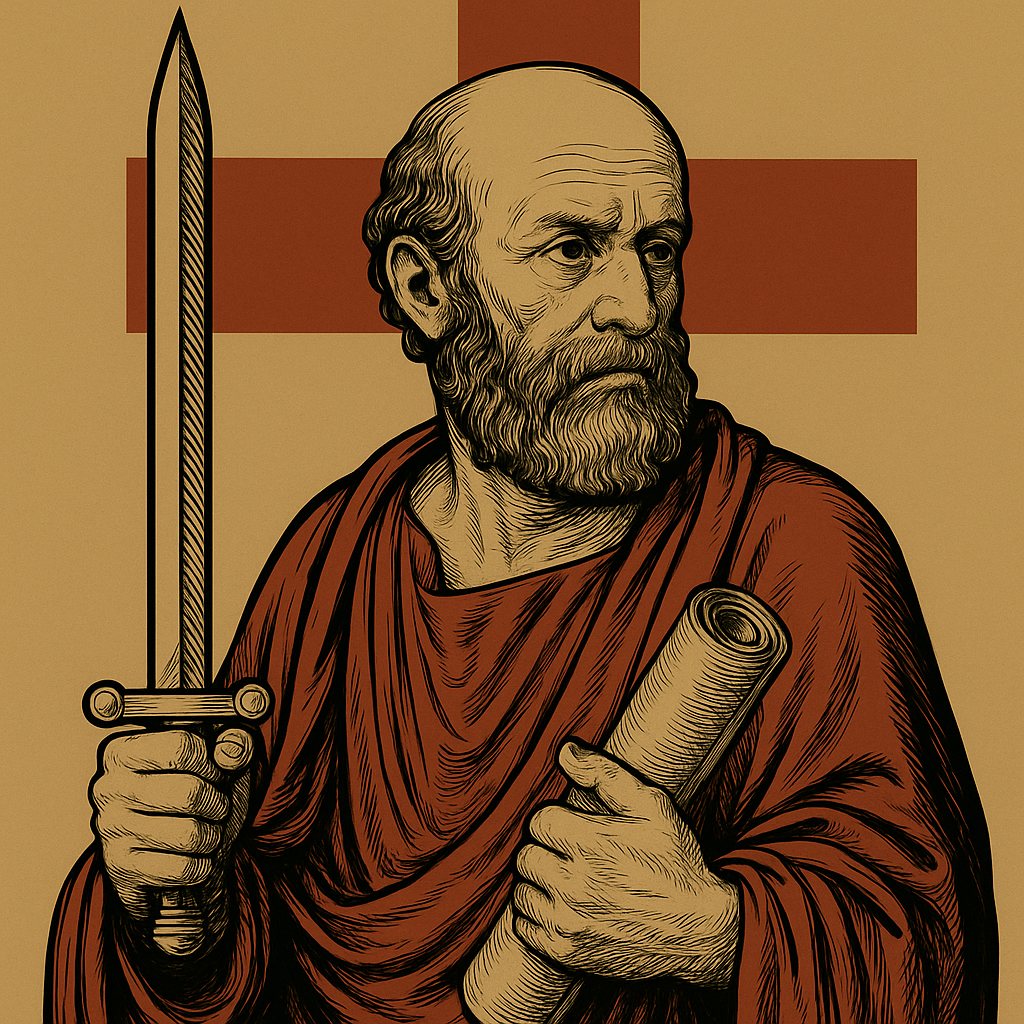
Soon after ʿĪsā ibn Maryam (ʿalayhi al-salām, peace be upon him) was raised to heaven, a Jew named Saul, a hardened opponent of his teaching, set out to divert his mission. Saul had a direct hand in the deaths of dozens of that teaching’s adherents, among them one of its earliest followers, Stephen.
Paul (c. 5 to 67 CE), before he became known as the foremost apostle (apostolos, ἀπόστολος) of Christianity, was a Jewish rabbi of the Pharisee school named Saul, in Greek Saulos (Σαῦλος) and probably in Hebrew Shaʾul (שָׁאוּל), of the tribe of Benjamin.4 According to the narrative in Acts, Saul studied the religious sciences in Islamicjerusalem under Gamaliel, a celebrated Jewish rabbi who died around the middle of the first century.5
Under Gamaliel
Gamaliel was a prominent Pharisee and the grandson of Hillel the Elder. He was respected for a moderate approach to the law of the Torah and held great influence in the Sanhedrin, the highest Jewish religious council, which handled matters of law and religious administration. That background exposed Saul to the teaching and the complex oral interpretation of the Jewish scholars.
Yet this connection is mentioned only in passing in Acts, and Paul never confirms it in any of his letters. The silence about Gamaliel raises questions about the claim. His theology, saturated with Graeco-Roman philosophy, runs against the conservative legal approach for which Gamaliel’s teaching is known; the pupil, qua theologian, owes nothing visible to the master.
Family
Information about Paul’s family is scarce, above all about his father. The father’s name appears in no reliable source, and nearly every detail about him is inferred from passing remarks in Acts.6
What can be confirmed is that he came from Tarsus, belonged to the tribe of Benjamin, was a Roman citizen and held to the Pharisee school. As a Roman citizen he passed that status to his son, which allowed Paul to move freely across the Roman Empire.
Paul’s statement that he was “the son of a Pharisee” suggests that both parents belonged to the same school. His father was probably a tentmaker, judging by Paul’s own trade.7 Paul also had a sister and a nephew,8 which points to a fairly large Jewish family rooted in the tradition of the Children of Israel.
In Acts, Paul says of himself:
3I am verily a man which am a Jew, born in Tarsus, a city in Cilicia, yet brought up in this city at the feet of Gamaliel, and taught according to the perfect manner of the law of the fathers, and was zealous toward God, as ye all are this day.1
6But when Paul perceived that the one part were Sadducees, and the other Pharisees, he cried out in the council, Men and brethren, I am a Pharisee, the son of a Pharisee: of the hope and resurrection of the dead I am called in question.2
Paul’s declaration of himself as a Pharisee at that moment reads as more than a statement of identity. Knowing the council was made up of Sadducees and Pharisees, two schools sharply divided on the resurrection, Paul exploited the division to set off an internal quarrel.
That diverted attention from the original charge, and it shows his readiness to use theological splits for his own ends. The tactic recurs in other episodes recorded in Acts.
A Herodian connection?
Some modern scholars suggest that Saul had blood ties to the Herodian family. In the letter to the Romans he calls a man named Herodion his “kinsman” (συγγενής, syngenēs),9 and he sends greetings to the household of Aristobulus,10 names commonly associated with the Herodian dynasty.11 One reading of these references is that Saul came from a Herodian line, and that this family tie is what won him protection from the authorities when he was stirring up trouble in Islamicjerusalem.12
Several of Paul’s close associates, such as Silas, Manaen and Lucius at Antioch, also have backgrounds that connect to Herodian circles. Manaen is called “brought up with Herod the tetrarch” (Herod Antipas), and Lucius of Cyrene, very possibly the same person as the author of the Gospel of Luke, is linked to the Hellenistic Jewish elite.13
Robert Eisenman also connects the pro-Roman, anti-Zealot features of Paul’s doctrine, as in Romans 13, with the Herodian policy of compromise with the occupying power. Paul’s cosmopolitan manner, his tolerance of breaches of the law, and his rhetoric abolishing circumcision and kosher food match closely, in Eisenman’s reading, the Herodian social philosophy, which was open to foreign influence and Roman dominance.14
An early tradition preserved by Epiphanius (c. 310 to 403) in the text Anabathmoi Iakobou goes further, and says that Paul was originally a Gentile who converted to Judaism to marry the daughter of the High Priest. When that hope failed, he is said to have turned against the law and become the chief opponent of circumcision and the Torah.15
No primary historical source, neither Paul’s own letters nor the Antiquities of Flavius Josephus, confirms any family link between Saul and the Herodian line. The connection remains, at most, a prima facie case built on names.16 The “Saul” whom Josephus mentions briefly in the context of riots in Islamicjerusalem cannot be identified with confidence as the Paul of the New Testament.17
Tarsus
Tarsus was an important cultural center in southeastern Anatolia.18 More than 300 years before Paul it was already the leading city of the region,19 with a strategic trading port on the eastern Mediterranean.20
It was known as the birthplace of many prominent philosophers and was home to a large Diaspora Jewish community. That community had supported Roman military campaigns against piracy and Parthian attack, and Julius Caesar rewarded it with Roman citizenship, a privilege rarely granted and greatly prized.21
After finishing his studies Saul returned to Tarsus to help his father as a merchant, and at the same time worked to spread Pharisee Judaism among his own people. The Pharisee school was the strongest opponent of the mission of ʿĪsā al-Masīḥ at the time.
Saul hoped that the new teaching would weaken for want of a following. The opposite happened. The teaching of ʿĪsā al-Masīḥ, spread by his followers under Peter, one of his most faithful disciples, grew by the day.
Saul seemed close to despair, yet the intention to divert what the faithful followers were preaching remained fixed in him. What may have occurred to him at that point was to destroy the teaching of ʿĪsā ibn Maryam from within.22
To persuade the followers of ʿĪsā ibn Maryam to accept him, Saul had to show proof that he had received a message directly from ʿĪsā ibn Maryam, so that he could be appointed one of his legitimate followers. That is the way he could carry out his subversion from the inside.
A persona for every audience
One feature that raises doubt in any critical reading of Paul is the shifting, layered way he declares his identity in Acts. To the crowd he is “a Jew of Tarsus.”23
To the centurion he is “a Roman.”24 Before the Sanhedrin he is “a Pharisee, the son of a Pharisee.”25
These statements do not formally contradict one another. The inconsistency in how and when he deploys them points to an opportunistic shaping of self-image that changes with the audience. In the terms of modern rhetoric, Paul presents a persona multiplex, a figure who adopts several faces of identity strategically to reach a particular goal.
In one of his letters Paul admits as much: that he was ready to adapt himself to anyone, to be like a Jew among Jews and like a Gentile among Gentiles, to gain influence over them.
19For though I be free from all men, yet have I made myself servant unto all, that I might gain the more. 20And unto the Jews I became as a Jew, that I might gain the Jews; to them that are under the law, as under the law, that I might gain them that are under the law; 21To them that are without law, as without law, (being not without law to God, but under the law to Christ,) that I might gain them that are without law. 22To the weak became I as weak, that I might gain the weak: I am made all things to all men, that I might by all means save some.3
If a preacher is willing to be “all things to all men,” the real foundation of belief has been sacrificed for acceptance and convenience. The ḥawāriyyūn (الحواريون, “the disciples”) preached on the basis of a fixed truth grounded in revelation.
Paul spread his message through a fabricated image and adaptation to context. His changing identity is therefore more than variation: it is a systematic misdirection that obscures the authenticity of the message of ʿĪsā ibn Maryam (ʿalayhi al-salām).
- Acts 22:3 (KJV). ↩
- Acts 23:6 (KJV). ↩
- 1 Corinthians 9:19–22 (KJV). ↩
- Acts 23:6; cf. Philippians 3:5. ↩
- Acts 22:3. See also David Wenham, Paul: Follower of Jesus or Founder of Christianity? (Grand Rapids: Eerdmans, 1995); Jerome Murphy-O’Connor, Paul: His Story (Oxford: Oxford University Press, 2004); N. T. Wright, Paul: A Biography (New York: HarperOne, 2018). ↩
- Acts 22:28. ↩
- Acts 18:3. ↩
- Acts 23:16. ↩
- Romans 16:11. ↩
- Romans 16:10. ↩
- Names such as Herodion and Aristobulus do occur in the Herodian line. See Richard Bauckham, Jude and the Relatives of Jesus in the Early Church (T&T Clark, 1990), pp. 67–69. ↩
- Robert Eisenman, James the Brother of Jesus (Penguin, 1997), pp. 105–109. Eisenman holds that a connection with the Herodian family may explain how Paul obtained political protection in Jerusalem. ↩
- Acts 13:1. The passage names Silas (probably the same as Silvanus), Manaen and Lucius of Cyrene as leading figures in the Antioch community. Of Manaen the text says: “Manaen, which had been brought up with Herod the tetrarch.” ↩
- Robert Eisenman, “Paul as Herodian,” Journal of Higher Criticism 3, no. 1 (1996): pp. 115ff. Eisenman links Paul’s attitude to Roman power and his loosening of Jewish law to the Herodian family’s politics of compromise with foreign rule. ↩
- ibid., pp. 120ff.; cf. Epiphanius of Salamis, Panarion 30.16.6–9. Epiphanius cites an Ebionite tradition from a text he calls the Anabathmoi Iakobou (“The Ascents of James”), which states that Paul was a Gentile of Tarsus who converted to Judaism to marry the High Priest’s daughter, and after failing turned against the Torah and became the chief opponent of the law. The text itself no longer survives and is known only through this citation. ↩
- Bart D. Ehrman, Peter, Paul, and Mary Magdalene (Oxford University Press, 2006), pp. 125ff. Ehrman rejects any blood relationship on the ground that the primary sources give no evidence of one. ↩
- Flavius Josephus, Antiquities of the Jews 20.9.1. Josephus mentions a “Saul” involved in political tension in Jerusalem, but his identification with Paul is disputed. The view remains an interesting speculation that the available historical evidence cannot confirm. ↩
- Tarsus was also the capital of Cilicia in Anatolia at the time. ↩
- G. Ernest Wright, Great People of the Bible and How They Lived (Pleasantville, NY: Reader’s Digest Association, 1974). ↩
- George T. Montague, The Living Thought of St. Paul (Milwaukee: Bruce Publishing, 1966). ↩
- N. T. Wright, Paul and the Faithfulness of God (Minneapolis: Fortress Press, 2013). ↩
- See the incident at Galatians 2:11–14. ↩
- Acts 21:39. ↩
- Acts 22:25. ↩
- Acts 23:6. ↩