
Look again at Saul’s early part in the war on the faithful followers of ʿĪsā ibn Maryam (ʿalayhi al-salām, peace be upon him). “The apostles” in Christian usage refers specifically to the followers of ʿĪsā ibn Maryam, the group the Qurʾān calls the ḥawāriyyūn (الحواريون, “the disciples”).
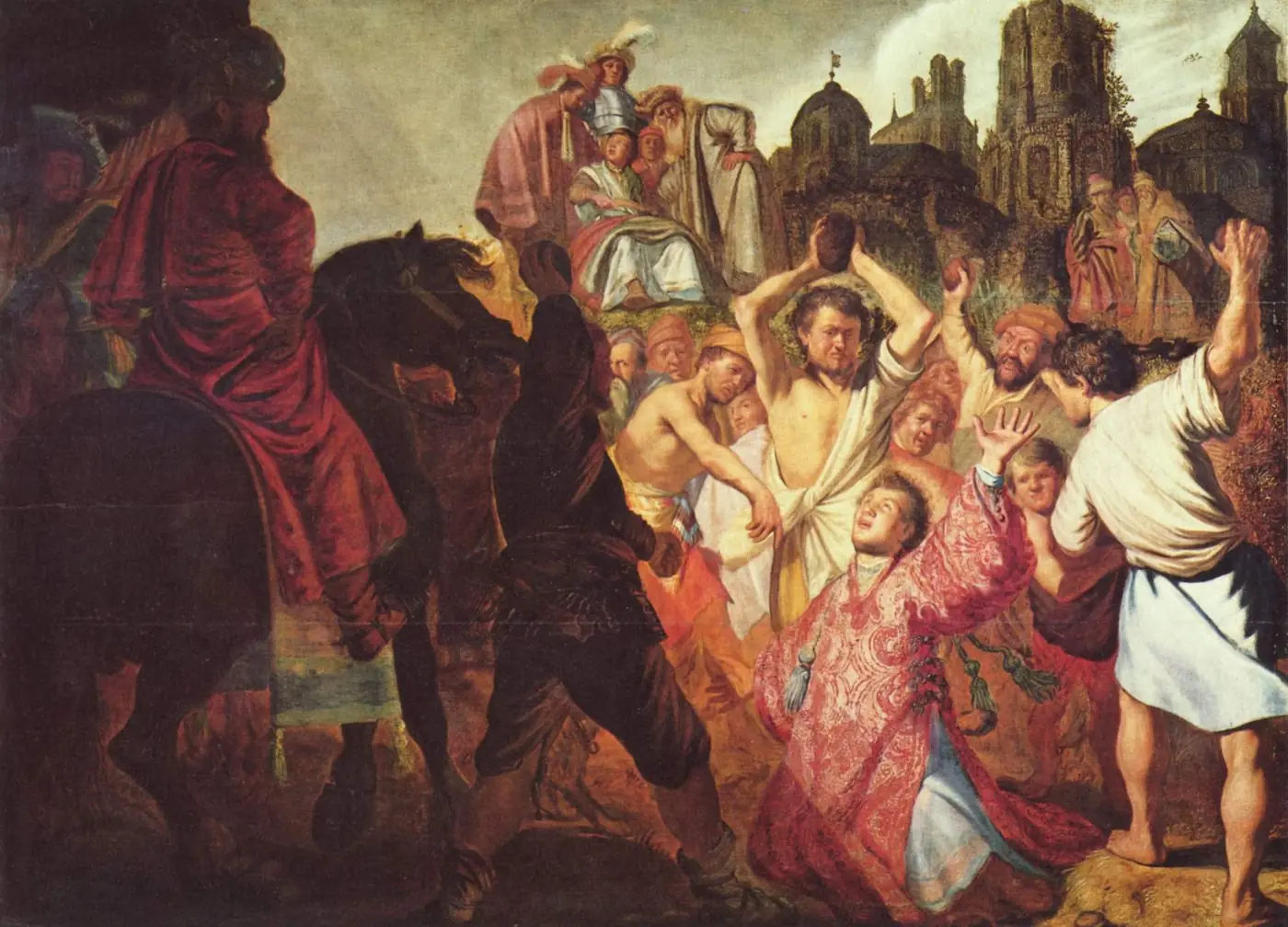
Saul bears responsibility for the killing of one of those followers, Stephen. Acts records it:
1Σαῦλος δὲ ἦν συνευδοκῶν τῇ ἀναιρέσει αὐτοῦ. Ἐγένετο δὲ ἐν ἐκείνῃ τῇ ἡμέρᾳ διωγμὸς μέγας ἐπὶ τὴν ἐκκλησίαν τὴν ἐν Ἱεροσολύμοις· πάντες δὲ διεσπάρησαν κατὰ τὰς χώρας τῆς Ἰουδαίας καὶ Σαμαρείας πλὴν τῶν ἀποστόλων. 2συνεκόμισαν δὲ τὸν Στέφανον ἄνδρες εὐλαβεῖς καὶ ἐποίησαν κοπετὸν μέγαν ἐπʼ αὐτῷ. 3Σαῦλος δὲ ἐλυμαίνετο τὴν ἐκκλησίαν κατὰ τοὺς οἴκους εἰσπορευόμενος, σύρων τε ἄνδρας καὶ γυναῖκας παρεδίδου εἰς φυλακήν.
1And Saul was consenting unto his death. And at that time there was a great persecution against the church which was at Jerusalem; and they were all scattered abroad throughout the regions of Judaea and Samaria, except the apostles. 2And devout men carried Stephen to his burial, and made great lamentation over him. 3As for Saul, he made havock of the church, entering into every house, and haling men and women committed them to prison.1
Saul’s cruelty toward the followers of ʿĪsā ibn Maryam is no secret, because the events are set down in the New Testament that Christians themselves hold sacred. The record is prima facie evidence against the sudden saint.
1Ὁ δὲ Σαῦλος ἔτι ἐμπνέων ἀπειλῆς καὶ φόνου εἰς τοὺς μαθητὰς τοῦ κυρίου, προσελθὼν τῷ ἀρχιερεῖ 2ᾐτήσατο παρʼ αὐτοῦ ἐπιστολὰς εἰς Δαμασκὸν πρὸς τὰς συναγωγάς, ὅπως ἐάν τινας εὕρῃ τῆς ὁδοῦ ὄντας, ἄνδρας τε καὶ γυναῖκας, δεδεμένους ἀγάγῃ εἰς Ἰερουσαλήμ. 3ἐν δὲ τῷ πορεύεσθαι ἐγένετο αὐτὸν ἐγγίζειν τῇ Δαμασκῷ, ἐξαίφνης τε αὐτὸν περιήστραψεν φῶς ἐκ τοῦ οὐρανοῦ,
1And Saul, yet breathing out threatenings and slaughter against the disciples of the Lord, went unto the high priest, 2And desired of him letters to Damascus to the synagogues, that if he found any of this way, whether they were men or women, he might bring them bound unto Jerusalem. 3And as he journeyed, he came near Damascus: and suddenly there shined round about him a light from heaven:2
4ὃς ταύτην τὴν ὁδὸν ἐδίωξα ἄχρι θανάτου, δεσμεύων καὶ παραδιδοὺς εἰς φυλακὰς ἄνδρας τε καὶ γυναῖκας, 5ὡς καὶ ὁ ἀρχιερεὺς μαρτυρεῖ μοι καὶ πᾶν τὸ πρεσβυτέριον· παρʼ ὧν καὶ ἐπιστολὰς δεξάμενος πρὸς τοὺς ἀδελφοὺς εἰς Δαμασκὸν ἐπορευόμην ἄξων καὶ τοὺς ἐκεῖσε ὄντας δεδεμένους εἰς Ἰερουσαλὴμ ἵνα τιμωρηθῶσιν.
4And I persecuted this way unto the death, binding and delivering into prisons both men and women. 5As also the high priest doth bear me witness, and all the estate of the elders: from whom also I received letters unto the brethren, and went to Damascus, to bring them which were there bound unto Jerusalem, for to be punished.3
58καὶ ἐκβαλόντες ἔξω τῆς πόλεως ἐλιθοβόλουν. καὶ οἱ μάρτυρες ἀπέθεντο τὰ ἱμάτια αὐτῶν παρὰ τοὺς πόδας νεανίου καλουμένου Σαύλου.
58And cast him out of the city, and stoned him: and the witnesses laid down their clothes at a young man’s feet, whose name was Saul.4
These texts show that Saul’s brutality is no false accusation from outsiders. The scripture of the Christians records it. A question follows: how could a man with a history of planned, systematic killing of the ḥawāriyyūn repent so easily?
Paul himself admits it in his letter to the Galatians:
13Ἠκούσατε γὰρ τὴν ἐμὴν ἀναστροφήν ποτε ἐν τῷ Ἰουδαϊσμῷ, ὅτι καθʼ ὑπερβολὴν ἐδίωκον τὴν ἐκκλησίαν τοῦ θεοῦ καὶ ἐπόρθουν αὐτήν, 14καὶ προέκοπτον ἐν τῷ Ἰουδαϊσμῷ ὑπὲρ πολλοὺς συνηλικιώτας ἐν τῷ γένει μου, περισσοτέρως ζηλωτὴς ὑπάρχων τῶν πατρικῶν μου παραδόσεων.
13For ye have heard of my conversation in time past in the Jews’ religion, how that beyond measure I persecuted the church of God, and wasted it: 14And profited in the Jews’ religion above many my equals in mine own nation, being more exceedingly zealous of the traditions of my fathers.5
Hatred without cause
The violence Saul showed in hunting the followers of ʿĪsā ibn Maryam was driven by more than religious duty or obedience to the highest religious authority. It reflects a deep ideological hatred.
In Jewish moral tradition, hatred of this kind is called sinat chinam (שִׂנְאַת חִנָּם, “hatred without cause”), hatred with no legitimate reason or real threat behind it. The term is found in the Psalms6 and in the Babylonian Talmud,7 where it is named the chief cause of the fall of the Second Temple.8
Paul’s conduct in the early part of his life fits that character: full of anger, hating without ground, ready to use violence to wipe out those who differed. His hostility to the ḥawāriyyūn was a hatred without cause, rooted in inner unease and in the threat their message posed to his own religious identity.
Saul then set out for Damascus to hunt the followers of ʿĪsā ibn Maryam. On that road, he claimed, he “met” Jesus Christ through an apparition from the sky. Suddenly he declared that he had repented of his crimes against the supporters of the mission of ʿĪsā ibn Maryam, and that he was the most faithful follower of Jesus Christ.
Letters from the high priest
The pattern did not end with Saul. In Polis Raja Di Malaysia (Langgam Fikir, 2026), I recount how, after my own arrest by the Royal Malaysian Police, a case the police themselves closed with no further action and no charges, a police-produced video of the raid was taken up and circulated by long-standing opponents of my apologetics work. I draw the parallel with Saul directly:9
This kind of behaviour—the obsessive character assassination, the deliberate distortion of facts, the gleeful amplification of unproven allegations, and the refusal to accept official exoneration—is not new. It follows a pattern as old as religious polemic itself, and its most instructive precedent is Paul of Tarsus, the most obvious bastard apostle in history.10
Before his conversion, Saul of Tarsus did not engage his opponents. He processed them. He obtained letters from the high priest authorising him to pursue Christians to Damascus and bring them back bound for trial (Acts 9:1-2). The letters were his weapon—not argument, not evidence, not theology. Institutional authority, converted into a mechanism for destruction. He breathed “threats and murder” against the early church (Acts 9:1), approved of Stephen’s stoning (Acts 8:1), dragged men and women to prison (Acts 8:3), and by his own later account “tried to destroy” the community he could not defeat on the merits (Galatians 1:13). Even post-conversion, Paul’s methods were still aggressive and often abrasive—he cursed those who preached a different gospel (Galatians 1:8-9), called his opponents “dogs” (Philippians 3:2), and wished certain agitators would castrate themselves (Galatians 5:12).
The men who targeted me followed this method precisely. They did not engage a single argument I had made across decades of apologetics work. They used a government-produced video—institutional authority, converted into a mechanism for destruction—and repeated it across platforms until repetition became its own form of evidence. The PDRM gave them their letters from the high priest. They did the rest.
Throughout the ordeal, the Muslim community online remained supportive. I did not lose the constituency that my apologetics work serves. The attacks came exclusively from those who had opposed my work before the arrest and who saw the PDRM video as an opportunity to discredit a voice they could not answer on the merits. The video gave them a weapon that required no theological argument, no scriptural evidence, no intellectual engagement—only repetition.
And repetition, on the internet, is its own form of evidence.
- Acts 8:1–3 (SBLGNT; KJV). ↩
- Acts 9:1–3 (SBLGNT; KJV). ↩
- Acts 22:4–5 (SBLGNT; KJV). ↩
- Acts 7:58 (SBLGNT; KJV). ↩
- Galatians 1:13–14 (SBLGNT; KJV). ↩
- cf. Psalms 35:19, 69:4. ↩
- Yoma 9b. ↩
- See Jonathan Sacks, Not in God’s Name: Confronting Religious Violence (New York: Schocken Books, 2017), p. 218; and Rabbi Doron Perez, “Sinat Chinam: From Dispute to Demonization,” HaMizrachi, Tisha B’Av 2020, p. 3. ↩
- Mohd Elfie Nieshaem Juferi, Polis Raja Di Malaysia: Power, Corruption & Control in Malaysia’s Police Force (Seri Kembangan: Langgam Fikir, 2026), pp. 142–144. ↩
- Paul (formerly known as Saul) of Tarsus identifies himself as a Pharisee from the tribe of Benjamin (Acts 23:6; 26:5; Philippians 3:5; Romans 11:1). These claims are preserved within the New Testament and ultimately derive from early Christian sources, including Pauline self-representation. There is no extant independent, contemporaneous evidence outside these sources that verifies his Pharisaic affiliation or tribal lineage. ↩