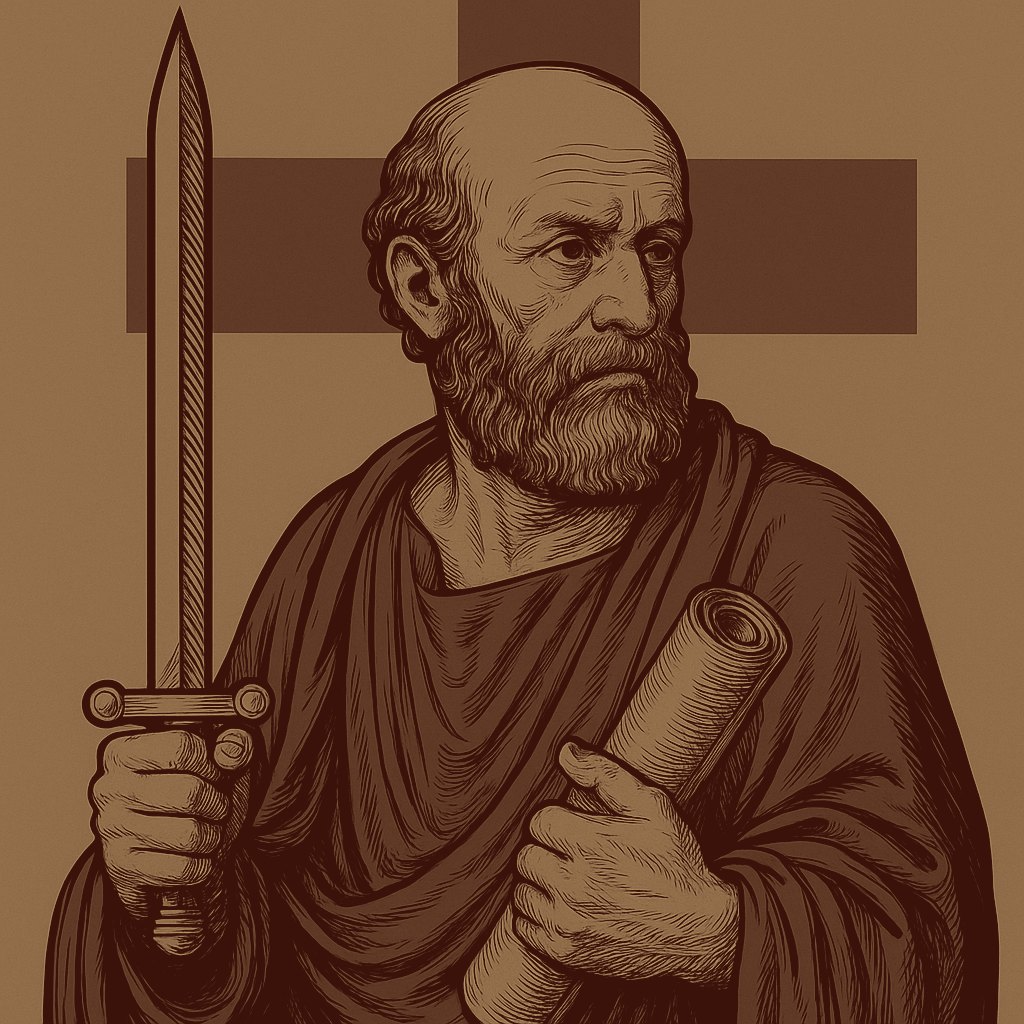
The psychological reading of Paul set out earlier shows a deep fracture in his personality, one that drove the construction of a new teaching as compensation for a dark past. Yet the question of Paul’s credibility is not confined to psychology or history. Within Islamic scholarship, Paul’s role and claims have been weighed critically for a very long time.
In recent times Christian missionaries have pressed the idea that Paul was one of the disciples, as if he belonged among the original followers of ʿĪsā ibn Maryam (ʿalayhi al-salām, peace be upon him) and inherited the teaching legitimately. They also claim that Muslim scholars “acknowledge” this. Is it so?
Their perception differs entirely from the judgment of Muslim scholars from the earliest times, who saw Paul as the corrupter of the tawḥīd (توحيد, “the oneness of God”) brought by al-Masīḥ ʿĪsā son of Maryam. These articles set out the authoritative Islamic view of Paul, so that the matter is made wholly plain.
The hadith
Muslims hold that between the mission of ʿĪsā al-Masīḥ and the Messenger of God ﷺ no prophet or messenger was sent, to the Jews or to anyone else. That rests on a hadith recorded by al-Bukhārī5 and Muslim:6
عن أبي هريرة قال: قال رسول الله صلى الله عليه وسلم: «أنا أولى الناس بعيسى ابن مريم في الأولى والآخرة». قالوا: كيف يا رسول الله؟ قال: «الأنبياء إخوة من علات، وأمهاتهم شتى، ودينهم واحد، وليس بيننا نبي».
ʿAn Abī Hurayrah qāla qāla Rasūlullāh ṣallā Allāhu ʿalayhi wa sallam: anā awlā al-nāsi bi-ʿĪsā ibn Maryam fī al-ūlā wa al-ākhirah. Qālū: kayfa yā Rasūlallāh? Qāla: al-anbiyāʾu ikhwah min ʿallāt, wa ummahātuhum shattā, wa dīnuhum wāḥid, wa laysa baynanā nabiyy.
Abū Hurayrah reported that the Messenger of God ﷺ said: “I am the nearest of all people to ʿĪsā the son of Maryam, in this world and the next.” They asked: “How so, Messenger of God?” He said: “The prophets are brothers of one father and different mothers; their religion is one, and there is no prophet between me and him.”
We know of only one man who claimed to be a messenger sent in the period between the mission of ʿĪsā ibn Maryam and the coming of the Messenger of God ﷺ: Paul himself.
Apostolos and rasūl
In Christian belief, Paul is regarded as an “apostle” (apostolos, ἀπόστολος) appointed by ʿĪsā ibn Maryam. According to the New Testament narrative, ʿĪsā ibn Maryam is said to have appeared to Paul after the crucifixion and appointed him apostolos to spread his teaching. Because Christians believe Jesus to be God, Paul is regarded as a “messenger of God” within their frame of belief.
The term “messenger” (rasūl) carries a very different meaning in Islam. In Islam a messenger is a human being who receives revelation and miracles from God, Lord of the worlds, to deliver the message of tawḥīd. In the Christian context, above all in the Malay world, the term refers to hoi apostoloi (οἱ ἀπόστολοι), the disciples who acted as preachers of the teaching of ʿĪsā al-Masīḥ.
The two words share a definiendum, one who is sent; they share no definiens, since what sends a rasūl is God and what sent an apostolos was a vision. The difference touches the epistemological foundation and the very concept of messengership.
The difference sharpens on examination of the core of Paul’s teaching. The chief focus of his theology is the death of ʿĪsā al-Masīḥ as the basis of the doctrine of salvation (sōtēria, σωτηρία), the crucifixion regarded as an atonement for the sins of humanity (hilastērion, ἱλαστήριον).7
The Qurʾān plainly rejects the narrative that ʿĪsā ibn Maryam was crucified or killed.8 Paul’s teaching contradicts divine revelation, and it also contradicts the principle of justice and moral responsibility brought by the earlier prophets: a direct relationship between the human being and God, with no need of a redeeming sacrifice.
The typological method of interpretation Paul used also reinforces the structure of his belief. Through it the original meaning of events in the earlier scriptures is reinterpreted symbolically to support new narratives such as the crucifixion and resurrection. From the standpoint of Islamic epistemology the method is rejected, because it departs from the literal, historical and original meaning of revelation.
In Islam, interpretation must rest on the apparent and objective meaning, and never on symbolic imagination constructed to support an outside doctrine. The whole theological edifice built on typology, including the concepts of blood sacrifice (haima, αἷμα), crucifixion (stauros, σταυρός) and the divinity of Jesus (theotēs, θεότης), can therefore be regarded as invention separate from the frame of authentic revelation. Islam affirms that sin cannot be redeemed by the sacrifice of another, still less by the death of a man regarded as holy or divine.
Paul’s own titles
Paul is said to have been sent “to the Gentiles” to preach to them the “good news”; he “was entrusted with the preaching” of the message he claimed from the gospel.9 In his own words he claims to be an “apostle”:
4For if he that cometh preacheth another Jesus, whom we have not preached, or if ye receive another spirit, which ye have not received, or another gospel, which ye have not accepted, ye might well bear with him. 5For I suppose I was not a whit behind the very chiefest apostles.1
Since Paul claimed that ʿĪsā ibn Maryam had sent him to all nations with particular teachings, it is logical to say that he named himself an “apostle” and used the title to raise his own name.10 The following passages from the New Testament show it plainly:
1Paul, a servant of Jesus Christ, called to be an apostle, separated unto the gospel of God,2
1Paul, called to be an apostle of Jesus Christ through the will of God, and Sosthenes our brother,3
1Paul, an apostle, (not of men, neither by man, but by Jesus Christ, and God the Father, who raised him from the dead;)4
On the strength of the hadith recorded by al-Bukhārī and Muslim, Islam plainly denies Paul’s so-called “apostleship” and disputes the claim that he was a “messenger of God,” since he lived in the period between ʿĪsā ibn Maryam and the Messenger of God ﷺ.
Ibn Isḥāq and the tafsīr of Yā Sīn
In several reports of the early Islamic tradition, Paul’s name appears among the figures associated with the spread of the teaching of ʿĪsā ibn Maryam, though never as a disciple. Ibn Isḥāq, the early Muslim historian, mentions Paul as a companion of Peter, sent by ʿĪsā ibn Maryam to convey the teaching of tawḥīd to the Romans:
Those whom Jesus son of Mary sent, both disciples and those who came after them, in the land were: Peter the disciple and Paul with him (Paul belonged to the followers and was not a disciple) to Rome. Andrew and Matthew to the land of the cannibals; Thomas to the land of Babel, which is in the land of the east; Philip to Carthage and Africa; John to Ephesus the city of the young men of the cave; James to Jerusalem which is Aelia the city of the sanctuary; Bartholomew to Arabia which is the land of Hijaz; Simon to the land of Berbers; Judah who was not one of the disciples was put in place of Judas.11
The report is also cited by al-Ṭabarī in his Tārīkh and in the Tafsīr of al-Qurṭubī.12 It must be understood that narratives of this kind rest on no decisive revelation. They depend largely on Isrāʾīliyyāt, Jewish and Christian traditions that seeped into early Islamic exegesis and history.
Another interpretation of interest in classical discourse links Paul’s name with Sūrah Yā Sīn (36:14), which speaks of three messengers sent to a people who rejected them. Some exegetes such as al-Baghawī and Ibn Kathīr13 mention that two of the messengers were John and Paul, and the third Simon Peter. Such interpretation shows the early tendency of some exegetes to match the Qurʾānic narrative with the history between revelations, an approach also much influenced by Isrāʾīliyyāt.
The appearance of Paul’s name in these commentaries cannot be taken as confirmation of his teaching, still less as recognition of his “apostleship” within the frame of Islamic belief. It is better seen as an early effort by some exegetes to connect external history with the text of revelation, without any doctrinal validity resting on sound Islamic sources.
Ibn Kathīr, for instance, stresses that the city meant in the verse is not Antioch, as more than one of the salaf stated. He also cites various other opinions on the names of the three who were sent, which do not mention Paul at all. The word used in the verse is mursalīn (“those sent”), and not rasūl in the sense of a Prophet or Messenger sent by God.
The term can refer to someone sent by a Prophet, such as the ḥawāriyyūn (الحواريون, “the disciples”) sent by ʿĪsā ibn Maryam, and need not mean a Prophet or Messenger himself.14 If the city is not Antioch, the connection with Paul falls of itself, and with it the effort to make him part of the Qurʾānic narrative.
- 2 Corinthians 11:4–5 (KJV). ↩
- Romans 1:1 (KJV). ↩
- 1 Corinthians 1:1 (KJV). ↩
- Galatians 1:1 (KJV). ↩
- Ṣaḥīḥ al-Bukhārī 3258. ↩
- Ṣaḥīḥ Muslim 2365. ↩
- 1 Corinthians 15:3. ↩
- Sūrah al-Nisāʾ 4:157. ↩
- Galatians 2:7–10. ↩
- See also 2 Corinthians 11:1, where Paul admits that his argument may look like “folly,” an irony that reflects the rhetorical unease in defending his standing as an apostle. ↩
- Alfred Guillaume (trans.), The Life of Muhammad: A Translation of Ibn Ishaq’s Sirat Rasul Allah (Oxford: Oxford University Press, 1998), p. 653. ↩
- Ibn Isḥāq, al-Sīrah al-Nabawiyyah; al-Ṭabarī, Tārīkh al-Rusul wa al-Mulūk, vol. 1, p. 123; al-Qurṭubī, Tafsīr al-Qurṭubī, on Sūrah 61:14. ↩
- See al-Baghawī 12; Ibn Kathīr, Tafsīr on Q 36:14; see also Samuel Zinner, The Gospel of Thomas in the Light of Early Jewish, Christian, and Islamic Esoteric Trajectories (Brill, 2011), pp. 112–113. ↩
- Ibn Kathīr, Tafsīr al-Qurʾān al-ʿAẓīm, on Sūrah Yā Sīn, verses 13–14. ↩