
How many times was Paul in prison? Acts names three stretches: a night at Philippi, two years at Caesarea and two years at Rome. Paul says there were more, and he signs letters as a prisoner. Acts ends with him still in custody, so the story of his chains has no last chapter.
The first stay is short. At Philippi the magistrates had Paul and Silas beaten, and “they threw them into prison, ordering the jailer to keep them safely”.1 The jailer “put them into the inner prison and fastened their feet in the stocks”. Only the next morning does Paul mention his citizenship: “They have beaten us publicly, uncondemned, men who are Roman citizens, and have thrown us into prison”.2 The claim came after the blows, and the question of that citizenship is a case of its own.
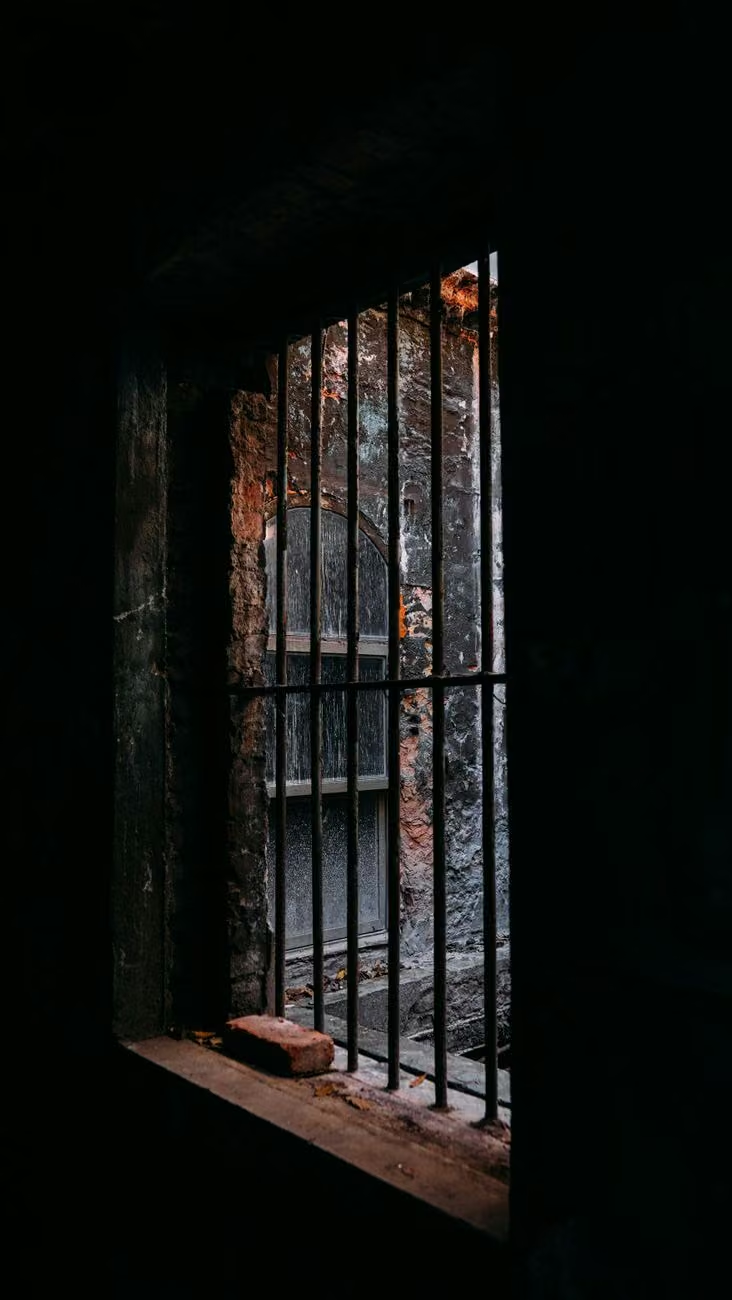
The long stay comes after Jerusalem. The tribune “arrested him and ordered him to be bound with two chains”.3 Paul was taken to Caesarea, where the governor Felix kept him. Paul says he had come to Jerusalem “to bring alms to my nation and to present offerings”,4 which is the collection set out in The purse. Felix had a reason of his own for keeping him: “he hoped that money would be given him by Paul”.5
“When two years had elapsed, Felix was succeeded by Porcius Festus. And desiring to do the Jews a favor, Felix left Paul in prison”.6 Two years, and no verdict.

Festus reopened the case, and Paul used the one door still open to a citizen: “I appeal to Caesar”.7 The Lord had told him where it would lead: “so you must testify also in Rome”.8 King Agrippa then gave the most telling line in the book: “This man could have been set free if he had not appealed to Caesar”.9 The appeal kept Paul from Jerusalem and sent him to Rome in chains.

At Rome Paul “was allowed to stay by himself, with the soldier who guarded him”.10 He “lived there two whole years at his own expense, and welcomed all who came to him, proclaiming the kingdom of God and teaching about the Lord Jesus Christ with all boldness and without hindrance”.11 Then the book stops. There is no hearing before Caesar, no verdict and no death. How did Paul die? A death the scriptures never record follows that silence.
Paul’s own letters add to the record. In Philippians he writes that “it has become known throughout the whole imperial guard and to all the rest that my imprisonment is for Christ”.12 Philemon opens “Paul, a prisoner for Christ Jesus”.13 Colossians closes with “Remember my chains”,14 and Ephesians calls him “a prisoner of Christ Jesus”.15 Where he was held when he wrote Philippians and Philemon is still argued: Rome, Caesarea or Ephesus.
The count does not fit Acts. Second Corinthians was written before the arrest at Jerusalem, and by then Acts knows of one night at Philippi. Yet Paul tells the Corinthians he has endured “far more imprisonments” than the rivals he is answering.16 Either Luke left some out, or Paul was counting generously. I cannot tell which.
That leaves a reader with the same gap at the end. Paul was in chains for the last years Acts describes, and it never says what Rome decided. The journeys that brought him there are in Paul’s missionary journeys: the routes Acts records, and the dates are set out in Timeline of Paul’s life.
Paul in prison: questions readers ask
How many times was Paul in prison?
Acts records Philippi, two years at Caesarea and two years at Rome. Paul himself claims “far more imprisonments” than his rivals (2 Corinthians 11:23), so some are unrecorded.
Where was Paul imprisoned?
At Philippi (Acts 16), briefly at Jerusalem, for two years at Caesarea (Acts 24:27) and for two years at Rome (Acts 28:30). Some scholars add Ephesus, which Acts does not mention.
How long was Paul in prison?
Acts gives two years at Caesarea and two at Rome, so about four years in custody, plus the voyage between and a night at Philippi.
Did Paul write letters from prison?
Philippians and Philemon speak of his imprisonment, and most scholars accept both as his. Colossians and Ephesians do too, and their authorship is disputed.
Was Paul released from prison?
Acts does not say. It ends with Paul under guard at Rome, preaching “without hindrance” (Acts 28:31).
- Acts 16:23–24. ↩
- Acts 16:37. ↩
- Acts 21:33. ↩
- Acts 24:17. ↩
- Acts 24:26. ↩
- Acts 24:27. ↩
- Acts 25:11. ↩
- Acts 23:11. ↩
- Acts 26:32. ↩
- Acts 28:16. ↩
- Acts 28:30–31. ↩
- Philippians 1:13. ↩
- Philemon 1:1. ↩
- Colossians 4:18. Many scholars doubt that Paul wrote Colossians; see The letters of a man. ↩
- Ephesians 3:1. The same doubt applies to Ephesians. ↩
- 2 Corinthians 11:23. ↩
Scripture quotations are from the ESV® Bible (The Holy Bible, English Standard Version®), © 2001 by Crossway, a publishing ministry of Good News Publishers. ESV Text Edition: 2025. The ESV text may not be quoted in any publication made available to the public by a Creative Commons license. The ESV may not be translated in whole or in part into any other language. Used by permission. All rights reserved.