
Every mission needs money, and Paul’s letters say more about money than about the life of ʿĪsā ibn Maryam (ʿalayhi al-salām, peace be upon him). The confession that he “robbed other churches” is examined under The character.6 This article follows the purse itself: the trade, the wages, the great collection for Islamicjerusalem, and the suspicion that followed it.
The trade
Acts records that Paul was a tentmaker by craft and worked at it in Corinth with Aquila and Priscilla.7 He made the fact a point of pride. To the Thessalonians he wrote that he had laboured night and day so as to be chargeable to none of them; to the Corinthians that he had preached the gospel without charge.8
18τίς οὖν μού ἐστιν ὁ μισθός; ἵνα εὐαγγελιζόμενος ἀδάπανον θήσω τὸ εὐαγγέλιον, εἰς τὸ μὴ καταχρήσασθαι τῇ ἐξουσίᾳ μου ἐν τῷ εὐαγγελίῳ.
18What is my reward then? Verily that, when I preach the gospel, I may make the gospel of Christ without charge, that I abuse not my power in the gospel.1
The boast sits inside a long defence of his right to be paid. In the same chapter he argues that the ox treading the corn is not to be muzzled, that those who minister at the altar live from the altar, and that the Lord ordained that those who preach the gospel should live of the gospel.9
He then declares that he has used none of these things. The chapter claims a right and renounces it in one breath, and it does so before a church that had begun to ask questions.
The collection
The largest financial undertaking of Paul’s life was a fund. At the council in Islamicjerusalem, by his own account, James, Cephas and John gave him the right hand of fellowship on one condition: that he remember the poor, “the same which I also was forward to do.”10
For years afterward his letters organize the collection. The Corinthians are to lay by in store on the first day of every week; Macedonia and Achaia have made a contribution for the poor saints at Islamicjerusalem; he will carry it there himself.11
25νυνὶ δὲ πορεύομαι εἰς Ἰερουσαλὴμ διακονῶν τοῖς ἁγίοις. 26εὐδόκησαν γὰρ Μακεδονία καὶ Ἀχαΐα κοινωνίαν τινὰ ποιήσασθαι εἰς τοὺς πτωχοὺς τῶν ἁγίων τῶν ἐν Ἰερουσαλήμ. 27εὐδόκησαν γάρ, καὶ ὀφειλέται εἰσὶν αὐτῶν· εἰ γὰρ τοῖς πνευματικοῖς αὐτῶν ἐκοινώνησαν τὰ ἔθνη, ὀφείλουσιν καὶ ἐν τοῖς σαρκικοῖς λειτουργῆσαι αὐτοῖς.
25But now I go unto Jerusalem to minister unto the saints. 26For it hath pleased them of Macedonia and Achaia to make a certain contribution for the poor saints which are at Jerusalem. 27It hath pleased them verily; and their debtors they are. For if the Gentiles have been made partakers of their spiritual things, their duty is also to minister unto them in carnal things.2
The sentence in Romans states the terms. The Gentiles have been made partakers of the Jews’ spiritual things, and therefore owe them carnal things. The collection was the price of recognition: money from Paul’s churches to the community that doubted him, carried by Paul, so that the community might accept the churches and the man who founded them.
The suspicion
The Corinthians suspected him. Two chapters of 2 Corinthians plead for the fund; the closing chapters answer a charge.
Paul admits the accusation in the act of denying it: “being crafty, I caught you with guile.”12 He then asks whether Titus, whom he sent, made a gain of them, and whether he and Titus did not walk in the same spirit.13
17μή τινα ὧν ἀπέσταλκα πρὸς ὑμᾶς, διʼ αὐτοῦ ἐπλεονέκτησα ὑμᾶς; 18παρεκάλεσα Τίτον καὶ συναπέστειλα τὸν ἀδελφόν· μήτι ἐπλεονέκτησεν ὑμᾶς Τίτος; οὐ τῷ αὐτῷ πνεύματι περιεπατήσαμεν; οὐ τοῖς αὐτοῖς ἴχνεσιν;
17Did I make a gain of you by any of them whom I sent unto you? 18I desired Titus, and with him I sent a brother. Did Titus make a gain of you? walked we not in the same spirit? walked we not in the same steps?3
The questions answer themselves only if the reader trusts Titus. Paul had already told the same church that he sent a brother with Titus “avoiding this, that no man should blame us in this abundance which is administered by us.”14 A man who takes precautions against blame has been blamed.
20στελλόμενοι τοῦτο μή τις ἡμᾶς μωμήσηται ἐν τῇ ἁδρότητι ταύτῃ τῇ διακονουμένῃ ὑφʼ ἡμῶν, 21προνοοῦμεν γὰρ καλὰ οὐ μόνον ἐνώπιον κυρίου ἀλλὰ καὶ ἐνώπιον ἀνθρώπων.
20Avoiding this, that no man should blame us in this abundance which is administered by us: 21Providing for honest things, not only in the sight of the Lord, but also in the sight of men.4
The purse in the dock
Acts confirms that the money reached Islamicjerusalem and that it did Paul no good. Before Felix he says that after many years he came to bring alms to his nation and offerings.15 Felix kept him two years in prison and sent for him often, hoping, Luke records, “that money should have been given him of Paul, that he might loose him.”16
26ἅμα καὶ ἐλπίζων ὅτι χρήματα δοθήσεται αὐτῷ ὑπὸ τοῦ Παύλου· διὸ καὶ πυκνότερον αὐτὸν μεταπεμπόμενος ὡμίλει αὐτῷ.
26He hoped also that money should have been given him of Paul, that he might loose him: wherefore he sent for him the oftener, and communed with him.5
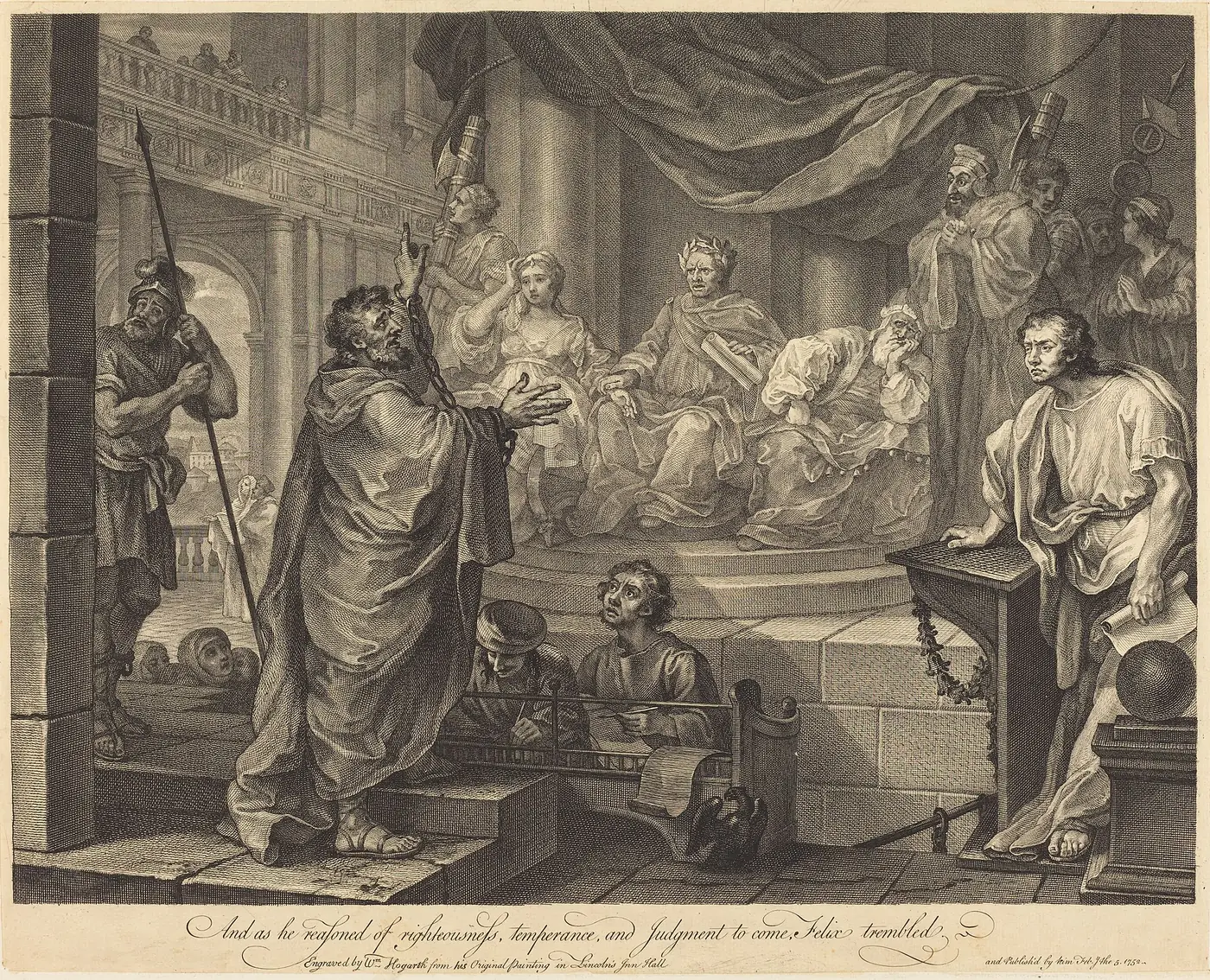
Jeremy Bentham, reading the trials of Paul as a lawyer in 1823, set this verse in his law report: a governor who expected a bribe from a prisoner with a purse.17 Acts does not say whether the bribe was paid. It says that Paul’s collection, gathered for the poor of the community that had received him on that condition, is last seen in the hands of a man kept two years in a Roman prison by a governor waiting to be paid.
What ʿĪsā ibn Maryam taught
The teacher Paul claimed to serve sent his disciples out with neither gold nor silver nor brass in their purses, and told them that a rich man enters the kingdom of heaven with more difficulty than a camel passes through the eye of a needle.18 The Qurʾān records that the disciples asked ʿĪsā ibn Maryam for a table from heaven, and that the messengers said to their peoples: “I ask of you no reward for it; my reward is only from the Lord of the worlds.”19
Paul organized a fund, defended his right to wages, renounced it under suspicion, took precautions against blame, and ended in a prison where a governor waited for his money. The purse tells its own story, and the story is not the one the messengers tell.
- 1 Corinthians 9:18 (SBLGNT; KJV). ↩
- Romans 15:25–27 (SBLGNT; KJV). ↩
- 2 Corinthians 12:17–18 (SBLGNT; KJV). ↩
- 2 Corinthians 8:20–21 (SBLGNT; KJV). ↩
- Acts 24:26 (SBLGNT; KJV). ↩
- 2 Corinthians 11:8. See Perjury, curses and the whited wall. ↩
- Acts 18:3. ↩
- 1 Thessalonians 2:9; 1 Corinthians 9:18. ↩
- 1 Corinthians 9:7–14. ↩
- Galatians 2:9–10. ↩
- 1 Corinthians 16:1–4; Romans 15:25–28. ↩
- 2 Corinthians 12:16. ↩
- 2 Corinthians 12:17–18. ↩
- 2 Corinthians 8:20. ↩
- Acts 24:17. ↩
- Acts 24:26. ↩
- Jeremy Bentham (as Gamaliel Smith), Not Paul, but Jesus (London, 1823), ch. XV, section 4, on Acts 24:26. ↩
- Matthew 10:9; 19:24. ↩
- Sūrah al-Māʾidah 5:112–114; Sūrah al-Shuʿarāʾ 26:109, 127, 145, 164, 180, the refrain of the messengers. ↩