Western sources have shown that Christian teaching today does not derive from the true message of ʿĪsā ibn Maryam ʿalayhi al-salām, peace be upon him, but that awareness is no discovery of contemporary scholars. As early as the eleventh century, the Muslim scholar Abū Rayḥān al-Bīrūnī (973–1048) affirmed that the name Christian, from the Greek Χριστιανός (Christianos), was never used by ʿĪsā ibn Maryam or his early followers.
It appeared later, introduced by the pagan society of Antioch around 40 to 44 CE.1 In his view the term does not represent the original teaching of ʿĪsā ibn Maryam; it reflects a new form of religion founded after he was raised to heaven.
This count applies the measure to Paul’s legacy: a church built on the transvaluation of the ethic of ʿĪsā ibn Maryam, and a prophecy that failed the first rule of truth.
More important, al-Bīrūnī stated that the true Injīl revealed to ʿĪsā ibn Maryam through the angel Jibrīl had been wholly altered or lost altogether. What is known as “gospel” today is a collection of four writings by different individuals, Matthew, Mark, Luke and John, each writing in a different language, place and social setting. These gospels, in al-Bīrūnī’s judgment, are historical records of the life of ʿĪsā ibn Maryam later united under one collective name, and no sacred revelation of the kind Muslims believe in.2
That view agrees with the argument that post-Pauline Christianity departed wholly from the line of the prophets and was rearranged as a new system of belief, built on the theology of the cross and the concept of a divine man, which ʿĪsā ibn Maryam never taught. Paul led the process of deviation, and the church institutions that arose after him entrenched it. Modern Christian teaching has left behind the inheritance of the Urgemeinde, the original community.
It rests on the interpretation of Paul’s theological system, which separated faith from the law and raised a sinful man as a divine substitute in the narrative of salvation. James, the brother of ʿĪsā ibn Maryam, who once led the early community in Islamicjerusalem, was sidelined and finally vanished from the official history of the church. No voice representing the original understanding of al-Masīḥ remained in the church structure after 70 CE.
The despair of Peter
One interesting reading of the shift in thought among the early followers of ʿĪsā ibn Maryam is found in a study by Baigent, Leigh and Lincoln. Their work tends to the sensational and sometimes oversteps academic bounds in its conclusions, but its content rests on careful historical research, above all on the early development of the church and the influence of Paul. They propose that figures such as Simon Peter suffered a spiritual crisis when the hope of the coming of the kingdom of God went unfulfilled.
In that despair, Paul’s theological interpretation appeared as a “spiritual promise” replacing the literal expectation of the kingdom. Peter, they suggest, finally adjusted his understanding to Paul’s new teaching to keep the movement alive.3
The reading fits the historical fact that after the destruction of Islamicjerusalem in 70 CE, Paul’s teaching went unchallenged and was raised as the chief basis of the new church, while opponents such as James disappeared from the mainstream record. Whatever its academic standing, its argument about the psychological and theological subjugation of the disciples by Paul strengthens the conclusion: Paul’s teaching succeeded through internal manipulation and structural collapse, and never through the strength of truth.

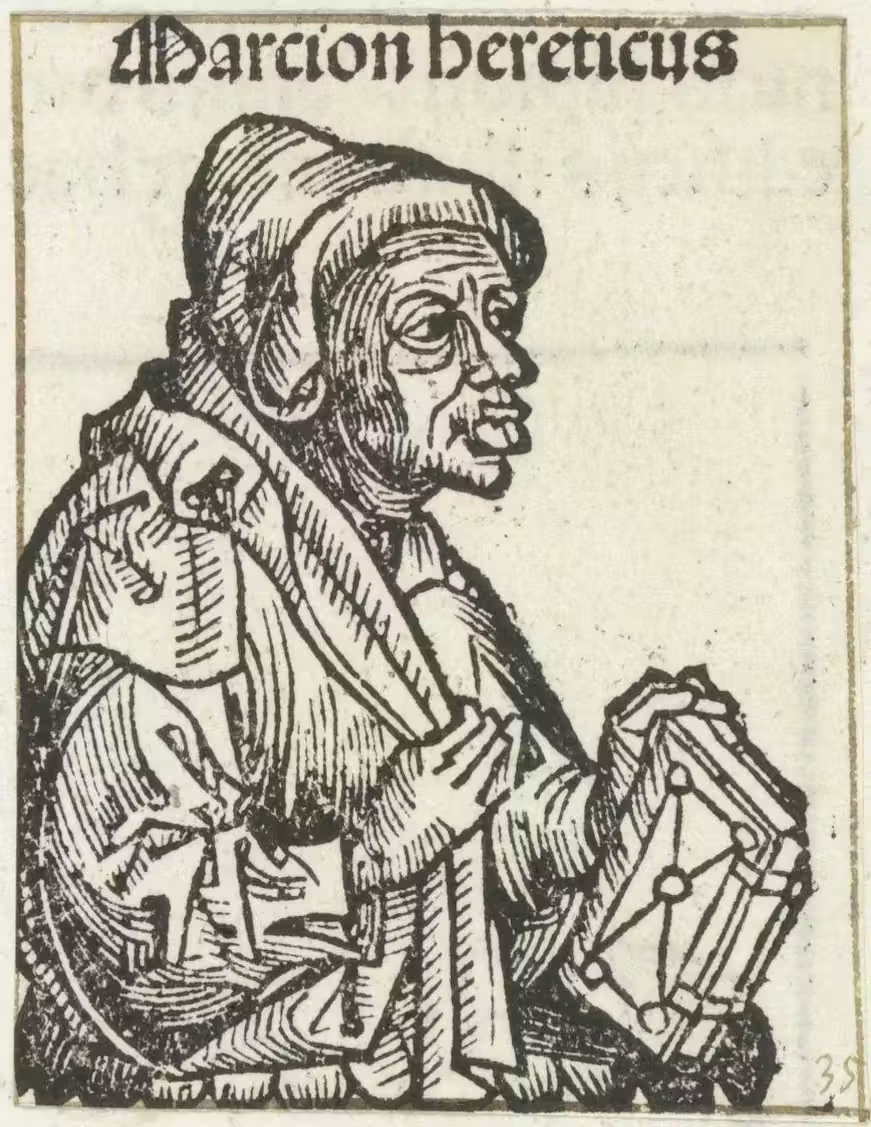
Marcion
The influence of Paul’s teaching can be traced from the earliest post-apostolic era, when early thinkers began to interpret and build theological frames on his writings. Among the first was Marcion of Sinope (c. 85–160 CE) in the middle of the second century.
Marcion rejected the whole Old Testament and introduced a doctrine of two gods: the wrathful, punishing God of the Old Testament against the God of love he believed Paul had introduced. Marcion accepted only an edited Gospel of Luke and ten letters of Paul as scripture; Paul’s teaching was the raison d’être of his church.
Marcionism was later declared heretical by the mainstream church, but the phenomenon shows that Paul’s teaching alone was strong enough to form a Christian movement almost wholly cut off from its Jewish roots and the Torah. That extreme interpretation was not accepted everywhere. Against Marcion stood the Ebionites, the Nazarenes and the other Jewish followers of ʿĪsā ibn Maryam, whose testimony is set out in a separate article.
- Acts 11:26. ↩
- Abū Rayḥān al-Bīrūnī, Kitāb al-Āthār al-Bāqiyah ʿan al-Qurūn al-Khāliyah, in Abdupattaev Mumin Mirzo Murodjon ugli, “Abu Rayhan Biruni’s Views on Christianity,” EPRA International Journal of Research and Development, vol. 9, no. 3 (March 2024), pp. 132–134. ↩
- Michael Baigent, Richard Leigh and Henry Lincoln, The Messianic Legacy (London: Jonathan Cape, 1986), pp. 84–90. ↩