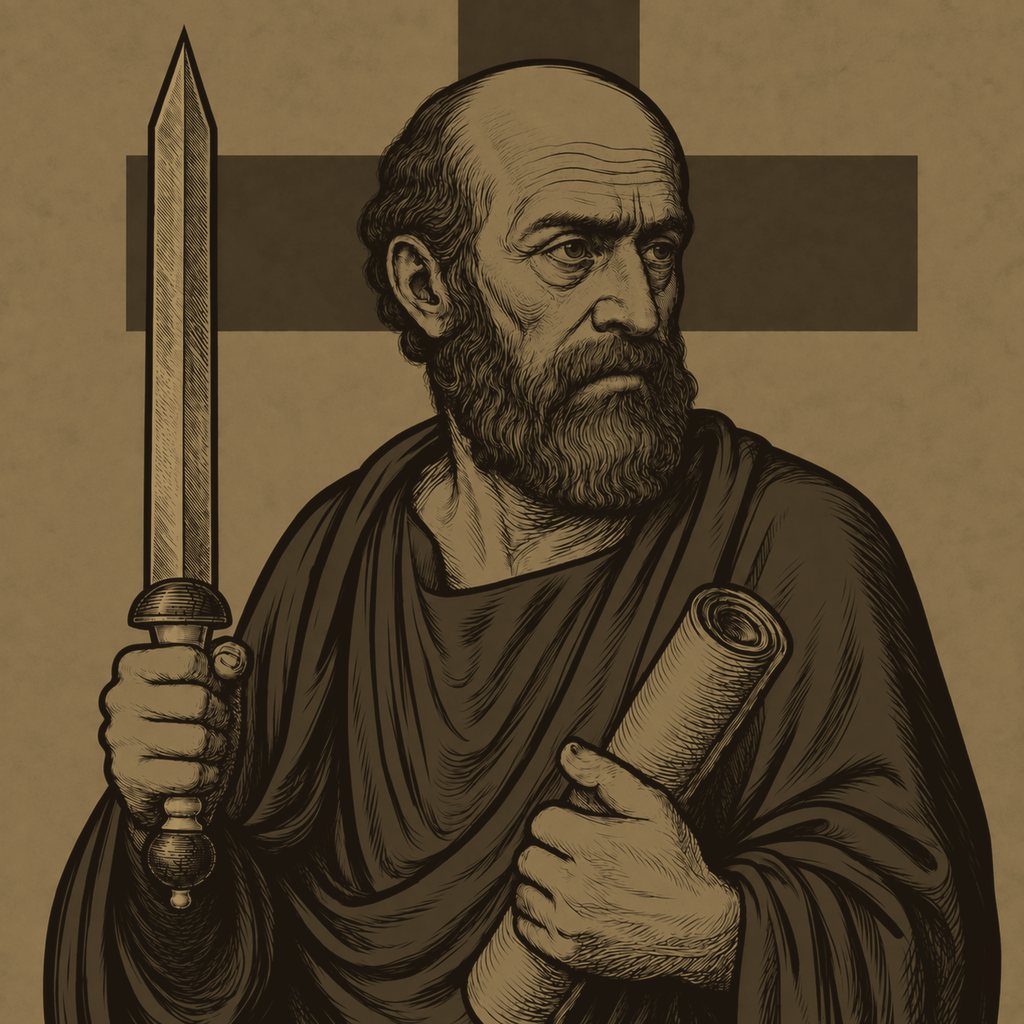
Dale B. Martin, who taught the New Testament at Yale for many years, sent the notes below to the author of this site in early 2023. They set out, section by section, why the Paul of the Acts of the Apostles and the Paul of his own letters cannot be the same man. Martin intended them as the start of a book, and had set the work aside for some time; he died in November 2023. They are published here with his permission.
The notes are reproduced exactly as he left them: his headings, his footnotes, his outline of the signs in Acts, and his own slips of spelling and reference. Nothing in his text has been corrected, shortened or restyled. The editor’s notes after his footnotes flag three references that point to the wrong verse. The notes end on a question he did not live to answer; this site takes it up in why-luke-does-not-know-pauls-letters.
The covering note
Mohd Elfie Nieshaem Juferi wrote the following summary on 19 February 2024, when he began a continuation of the notes. It stands at the head of the document and is kept here as it was written.
The revised article, originally introduced and partially authored by the late Dr. Dale B. Martin on March 18, 2019, and updated on May 31, 2019, explores the divergent portrayals of Paul the Apostle in his epistles versus the Acts of the Apostles. The “Luke/Acts and Paul: Direct Contradictions” section, added on June 5, 2019, delves into the discrepancies between Paul’s self-described experiences and those depicted in Acts. The continuation of this analysis by Mohd Elfie Nieshaem Juferi on February 19, 2024, further enriches the discussion, highlighting the scholarly effort to understand the complex narratives surrounding Paul within New Testament scholarship. This collective work seeks to clarify the historical and theological nuances of Paul’s representation in early Christian texts.
The notes
Why, in the title for this book, do I place the name of “Luke” in quotation marks but not the name of Paul? It is not meant as a disparagement of the author of what came to be called the Gospel of Luke and the Acts of the Apostles. It is to underscore, at least at the beginning (for I will dispense with the quotation marks soon), that we do not know who the author of the Third Gospel and Acts was. I will argue that it is almost certain that the author was not the “Luke” we read about in the New Testament and who has been credited as the author for the past two thousand years. But I have no other defensible suggestion for who the author may have been, and I don’t believe any other scholar, at least thus far in the history of interpretation, has a better suggestion. Yet I need to call the author something, and so “Luke” is as good a space-filler as any other. I will shortly get into other questions of authorship or identity, of Luke-Acts as well as other biblical and ancient texts, and will provide more discussion.
Most critical scholars, however, don’t entertain doubts that there was a “historical Paul” and that he was the author of what came to be much of the New Testament—meaning that we think we can read at least some of the letters in the New Testament as having been written by a real Jew who became a follower of Jesus Christ sometime after Jesus’s death. Paul believed he had been “called” by the resurrected Jesus to become a prophet, let’s say sometime around 34 or 35 CE, and then he set out to convince gentiles that they should also become followers of this crucified Jewish prophet. Most critical scholars believe that seven of the letters of the New Testament were actually written by Paul. We have doubts about the other letters, as I will explain below. So I don’t feel the need to put the name Paul in quotation marks. I believe there actually was a Paul who became a prophet of Jesus Christ and wrote at least seven letters that currently reside in our Bibles. I can’t say the same thing about “Luke,” because I doubt that the “Luke” mentioned in our Bibles was actually the author of the Third Gospel and Acts. Thus the difference in punctuation for the names of Paul and “Luke.”
As I already hinted, however, the presence of quotation marks around “Luke” throughout this book would be tedious. So I will from now on mostly dispense with them. But readers should keep in mind that I’m using the name “Luke” only as a place-holder for the author of the Gospel of Luke and the Acts of the Apostles. I believe, like most critical biblical scholars, that our canonical Gospels, and many later Gospels, were originally published anonymously or under a pseudonym (meaning either that the documents originally appeared without any attribution of authorship or a false one). I will argue that neither the Gospel of Luke nor the Acts of the Apostles was published by the “Luke” we find in the New Testament. What we can know about the actual author of these documents can be ascertained only by what we can glean from the writings themselves—such as what his background may have been; whether he was a Jew or a gentile; what his level of education was; and where geographically he came from, more or less. (I will assume it was a male author just because female authors are so rare for our extant documents from antiquity and early Christianity.) I will get to those issues also. But now is just the time to explain why I treat the name of “Luke” differently from the name of Paul.
The main point of this book is to demonstrate how the image, biography, theology, literary style, and methods of evangelism of Paul the Apostle are quite different from the portrait of Paul depicted in the Acts of the Apostles. Along the way, I must also demonstrate how the theology of the author of Luke and Acts is so different from the theology we get from Paul’s own letters. The author of Luke and Acts may have intended to represent the “real Paul,” and he may have thought he did so. But he did not. His “Paul” is very different from, in some ways diametrically opposed to, the “Paul” we may derive from a careful reading of Paul’s letters. So I have a few different tasks. I need to demonstrate what kind of “Paul” we see in Acts and contrast that to the “Paul” we get from Paul’s own letters. I also then need to explain the difference, which gets us into differences in history, biography, and even theology. Even the writing styles—and thus the educational levels— of the two authors must be explored.
Too many people—not only Christians but also secular scholars and historians—have assumed that a valid biographical, missiological, or theological account of Paul the Apostle can be derived from a combination of all the letters in the New Testament that claim to be by Paul and also from the Acts of the Apostles. My aim is to demonstrate that the different versions of Paul in the New Testament cannot be harmonized. They don’t need to be. We can talk about a “historical Paul”—that is, a Paul we historians can construct using his own first-hand writings—and other “canonical” Paul’s—whether derived from Luke and Acts or from the letters falsely published in his name also in the New Testament and other, post-biblical, sources. My point is that we are on better historical—and even theological—grounds if we don’t confuse all these different “Paul’s” together. We should be able to “see” a “historical Paul” as different from the “canonical Paul” of the New Testament or the “Paul” of Christian tradition and legend. There is nothing wrong with pointing out those differences. Or as I will call them, contradictions. And the place to start is with how “Luke” created a “Paul” completely different from the historical Paul. “Luke” versus Paul.
As I will show, there are many ways to show differences between Luke-Acts’s portrayal of Paul and Paul’s own self-presentation. Here I want to concentrate on contradictions between the two historiographical accounts that seem, at least to me, incontrovertible. On specific details of Paul’s biography, his practices, and his message, the author of Acts seems either not to know anything about the historical Paul or to deliberately misrepresent him.
We can begin with the early history of Paul’s career as a follower of Christ. We must keep in mind that Paul’s letters, on which we must depend for the only “first-hand eyewitness accounts” we possess of his life and ministry, come from around the 50’s CE or so. If he became a disciple of Jesus around 34 or 35, as most scholars have concluded, his letter to the Galatians, again as most scholars think, must be dated to around 15 to 17 or 18 years later, according to how we interpret a few verses in Galatians (see Gal 1:18 and 2:1). Let’s say generally that Paul’s main writings were composed around 50 to 55, or perhaps a few years before or after those dates. The Acts of the Apostles, on the other hand, has variously been dated to anywhere from 80 to 150 CE, so at least 30 years later than Paul’s letters. Simply by chronological proximity, Paul’s letters should carry more weight for the purposes of history. And of course, Paul’s letters (at least the seven deemed “undisputed”) should have precedent because having been written by Paul himself. We have no idea who wrote the Acts of the Apostles, as I will argue more fully below.
The Chronology and Geography of Paul’s “Conversion” and Early Ministry
Paul admits that he was a persecutor of followers of Jesus. By his account, that began in Damascus, and he was not in or around Jerusalem until years later. As he narrates what he did after his vision of Jesus: “I did not go up to Jerusalem to those who were apostles before me, but I withdrew to Arabia, and again I returned to Damascus” (Gal 1:17; emphasis added). Paul did not just “go to” Damascus; he “returned” there. What Paul means by “Arabia” is probably the desert region south of what we now consider Syria, perhaps a part of what is now Jordan, but in any case the land east of the Jordan River, that is, not “Judea” or “Israel.” When he says he “returned to Damascus” he is explicitly telling us that he went from Damascus, where he experienced his “call” to be a prophet and apostle, to “Arabia,” and then back to Damascus. Judea and Jerusalem are nowhere in his account.
The history told by Acts is completely different. Paul, here called “Saul,” is first seen in Jerusalem, where he witnesses the stoning of the disciple Stephen, even guarding the cloaks of those doing the stoning (Acts 7:58). He is well-known among the believers in Jerusalem and even all of Judea and Samaria as a persecutor of the movement, going “house to house” dragging believers to prison (Acts 8:3). Only later does he decide to go to Damascus to do the same (Acts 9:1-2). And it is only on his way from Jerusalem to Damascus that he experiences a “vision” of Jesus appearing to him in “a light from heaven” (Acts 9:3).
These two stories cannot responsibly be harmonized. Either Paul started out his “persecuting career” in Damascus (as Paul says), or he started it in Jerusalem, then Judea, then Samaria, and then with plans to carry it on in Damascus. To attempt to harmonize the two different accounts makes a mockery of the texts. If Paul is not lying or radically stretching the truth, the account in Acts cannot be historical.
So when did Paul first become known by sight to Christians in Judea? According to Paul, it was three years later. But he went, in seems, in cognito. He says that he visited only “Cephas” (the Aramaic equivalent for “Peter”) and James, the brother of Jesus, who was becoming the acknowledged leader of the church in Jerusalem (Gal 1:18-19), and he says that he stayed only fifteen days. He swears that he was completely “unknown by sight” by any other believers in Judea or Jerusalem. Then, after those fifteen days with Peter and James, Paul returned to Syria and Cilicia (now part of the modern nation of Syria and the south-eastern coast of Turkey, nowhere near Jerusalem: Gal 1:21).1 Paul goes out of his way to insist that this is the truth: “With what I am writing to you, I swear before God that I am not lying” (Gal 1:18).
Why is Paul telling his story this way, and even “swearing” that this is the truth? It cannot be because he knows the narrative of Acts, which is completely different. We have to remember that Paul was writing at least 30 years before Acts was written, and possibly as much as 50 to 100 years before it. The reason is that Paul, especially in Galatians but also in his other letters, is concerned to stress his independence from the “Jerusalem apostles.” He attempts to portray himself as an independent apostle who received all his knowledge through relevations directly from Jesus Christ. He is determined to put himself on equal footing with Peter, James, John, or any other apostle. So he emphasizes his distance, not connection, with Jerusalem.
But that is no reason to dismiss his account of his “apostolic beginnings.” After all, the people to whom he writes could easily have checked his account with disciples in other cities, including Jerusalem and Damascus. So if we, as historians, are bound to take seriously “first-person” accounts over accounts written decades later and by people not witness to what they describe, we should give great weight to Paul’s claims that he began his relationship to believers, as both a persecutor and then a believer himself, in Damascus. Only much later did he become acquainted with believers in Jerusalem—and they with him. There is simply no good reason to doubt that. Paul became well-known to Christians in Jerusalem and Judea, at least “by sight,” only several years after his “call” by Jesus to become an apostle, not several years before some “journey” from Jerusalem to Damascus as narrated by Acts. If Paul’s claims are correct, or even remotely accurate, the narrative accounts of his early experiences and travels narrated in Acts—in which he begins in Jerusalem and is in and out of Judea many times and is well-known by believers in those areas, even in person—must be dismissed as inaccurate.
Paul’s Missionary Practices
There are also clear contradictions between Acts and Paul in their depictions of his missionary activity. According to Acts, whenever Paul enters a new city or territory, almost every time he begins by preaching among Jews, either in their synagogues or wherever Jews tend to gather together to worship (for example, by the river in Philippi: Acts 16:13). Immediately after he is baptized, he “began to proclaim Jesus in the synagogues” of Damascus (Acts 9:20). First thing on the “missionary journey” narrated about Barnabas and Paul in Acts 13, Barnabas and Paul preach “in the synagogues of the Jews” in Salamis, a city of Cyprus (Acts 13:5). In Antioch of Pisidia (modern southern Turkey), they preach on the sabbath day in the Jewish synagogue (Acts 13:14-43). The next Saturday, when Paul and Barnabas return to speak again in the synagogue (13:42-43), “the Jews”—or at least many of them—become “jealous” and argue with Paul and Barnabas (13:44-45).
This is the point in the narrative in Acts about Paul that we see the repeated “turning point” of the Acts narrative about Paul. Facing rejection by “the Jews,” Paul rejects the rejection of “the Jews” and announces that he will “turn to the gentiles” The rejection of the gospel by “the Jews” leads to the mission to the gentiles by Paul (at this point along with Barnabas, though they will soon part company). The gentiles “rejoice,” and many of them become believers—but all because the Jews first the reject the message. The Jews react by stirring up persecution against Paul and Barnabas; Paul and Barnabas react by “shaking the dust off their feet” and going to the next town (13:48-52).
After this, the pattern repeats itself several times in Acts: Paul first preaches to Jews, often in synagogues; the Jews mostly reject his message; in reaction Paul moves on to preach to gentiles, usually with great success. It happens in Iconium (Acts 14:1-7); Philippi (16:13); Thessalonica (17:1-9); Beroea (17:10-14); Athens (17:17); Corinth (18:4-8); Ephesus (18:19); and again later in Ephesus (19:8-10). The pattern is clear: Paul almost always preaches first to Jews, either in the synagogue of the city if there is one, or at some “place of prayer” where Jews are known to meet. His message is accepted by a minority of Jews, but rejected by most. He then “shakes the dust off his feet” from their synagogue and goes to preach to gentiles, who overwhelmingly accept his message.
None of this is surprising for the Acts of the Apostles, or for the Gospel of Luke for that matter. A major theme of the very first sermon of Jesus in his hometown of Nazareth, according to Luke, is that God’s message is often rejected by “the Jews” only then to go out to “the nations” (i.e., gentiles), where it is better accepted (Luke 4:16-30). In the first verses of Acts, Jesus says that the message carried by his disciples will be preached first in Jerusalem, and then proceed to Judea, then to Samaria, and then “to the ends of the earth,” ending up in Rome, the capital city of the Roman “world empire” (Acts 1:8). A major theme of both Luke and Acts is that the gospel message, no matter who preaches it, must go first to “the Jews” and only after a rejection by them to “the gentiles,” that is “the nations.” So in Acts, Paul’s ministry is made to conform to this pattern also.
But that is not how Paul talks about his ministry. Consistently in his own letters Paul depicts himself as “the apostle to the nations” (that is, to the gentiles) in contrast to Peter (Cephas) whom he recognizes as “the apostle to the Jews.” Paul claims that God “called” him so that he could “proclaim the gospel among the nations” (remember: “the nations” is the same term that is often translated in modern English as “the gentiles,” that is not “Jews” or “Israel,” in normal ancient usage; Gal 1:16).2 Paul never mentions any kind of gospel he preached to Jews, but he does talk about “the gospel I preach to the gentiles” (Gal 2:2). He contrasts himself to Peter: “I had been made faithful for [been entrusted with] the gospel of the uncircumcised, as Peter of the circumcised” (Gal 2:7). He immediately then again contrasts his mission with that of Peter: “For the one who worked in Peter for the apostleship of the circumcised worked also in me for the nations” (2:8). And he confirms that this arrangement was agreed upon by the leaders of the Jerusalem church. James (the brother of Jesus and eventually head of the church in Jerusalem), Cephas (Peter), and John (son of Zebedee and one of the original twelve) agreed “that we [should go] to the nations, and they to the circumcised” (2:9). Every time Paul speaks of his own mission it is to gentiles (“the nations”), not to Jews. Paul could not be clearer: he did not see his mission as one addressed to his fellow Jews, but only to gentiles. In Paul’s mind, to have gone to synagogues throughout the Mediterranean would have been to encroach on the missionary territory of Peter and other apostles. And that was not, it seems clear, Paul’s style.
My argument can be proven by a closer analysis of the founding of the church in Thessalonica. If one were to read 1 Thessalonians with no knowledge of the narrative of Acts, one would assume (as many scholars have argued) that the church in Thessalonica was composed completely of gentiles. No Jews are mentioned at all as members of the community. Paul addresses his letter’s recipients as people who were previously worshippers of “idols” who after his message turned away from their previous false gods “to serve the living and true God” (1 Thess 1:8). That last phrase was a favorite of Jews who wanted to distinguish themselves—as serving a “living and true God”—from “the nations” who served “false,” or “dead,” or non-existent “gods.” Paul is clearly addressing a group of people he considers to be former gentiles. Paul does mention Jews, including Jews who believe in Jesus. And he compares them with his new converts in Thessalonica (1 Thess 2:14). But the comparison is apt only because Paul is, quite self-consciously, comparing a gentile church with the Jewish churches in Judea. He is saying that the gentile believers in Thessalonica have experienced the same persecution from their own people as the Jewish believers in Judea experienced from their own people. The ethnic distinction is obvious: the Thessalonian church is gentile; the Judean churches are, at least predominately, Jewish.
That the newly converted believers in Thessalonica are gentiles is born out by the fact that they know just about nothing about Jewish teachings of the resurrection until Paul “fills them in” with this letter. Paul had apparently not told them what to expect if their fellow believers died before the coming of Jesus. Thus, he writes 1 Thess 4:13-18 to explain to them his own doctrine, which he got from Judaism, about the resurrection of the body. He must have told them that Jesus’s “coming” (parousia) was to be soon and sudden (1 Thess 5:1). But he had apparently not told them about any other aspect of “life after death” or the resurrection of the body—ideas that would be well-known by just about any Jew of the time, even those who may not have believed in it.
There is no mention of any person in 1 Thessalonians we may take to be a Jewish believer in the community there. Paul is clearly writing to a fully gentile congregation. This makes perfect sense given the fact that he saw himself as “the apostle to the gentiles” and not to “the Jews.” The Thessalonian church is, for all practical purposes, a completely gentile church.
But that is not how the author of Acts presents it. As the author of Acts tells the story, Paul in Thessalonica first goes to the Jewish synagogue, as he has elsewhere as we have seen above (Acts 17:1). In fact, we’re told he went there three straight Saturdays to argue that Jesus was the Messiah (17:2-3). Moreover, he was successful with at least “some of them,” who accepted his message (Acts 17:4). Others who accept his message are “devout Greeks” (that is, probably, gentiles who made a practice of attending the Jewish synagogue but without complete conversion and circumcision) and important women of the town. So already from the third week of Paul’s visit to Thessalonica, the number of believers in Christ include both Jews and gentiles. We readers of Acts are to assume, I’m sure, that the author intends to depict a Christian congregation that is a mixture of pious Jews, god-fearing gentiles, and important gentile women of the town. This is to be expected given this author’s practice of narrating the beginnings of Paul’s churches. But it cannot be historical given what we see from 1 Thessalonians. Paul did not go to the synagogue in Thessalonica. He did not preach to the Jews there because he would have viewed that as the “mission” of others, not his own mission. And the early church in Thessalonica was not a mixed congregation of Jews and gentiles. It was a gentile church, as is clear from Paul’s letter to them. The “history” of Paul’s ministry as recorded in Acts is simply not historically accurate. Our comparison of 1 Thessalonians (Paul’s own account as an eye-witness) with the Acts account (from years later and written by someone who was apparently not an eye-witness) of the foundation of the church in Thessalonica provides weighty evidence that Acts’s “history” of Paul’s ministry is not “history.” It is fiction.
Paul as Public Speaker and Rhetorician
The author of Acts goes out of his way to portray Paul as a trained, practiced, and excellent rhetorician. The author of Acts presents Paul as giving powerful speeches, recognized by everyone in the narrative as eloquent, and in both Greek and Hebrew (Acts 21:40 – 21:21; 24:10-23; 26:1-32). In fact, Paul moves easily between Greek and Hebrew, to the surprise of at least one of the other characters in the narrative (Acts 21:37).
The author of Acts on more than one occasion mentions that Paul begins a speech of “defense” (an apologia) with the requisite captatio benevolentiae, the first part of the speech designed to “capture the benevolence” of his audience by complimenting them, something taught in rhetorical training (Acts 24:10; 26:2-3). Luke even mentions that Paul gestures correctly with his hand, as any teenage boy would have been taught in rhetorical training. Boys in schools of rhetoric were generally instructed to gesture with the right hand while leaving the left hand either in the toga (or, in the Greek equivalent, a cloak or himation) or holding a scroll. This is the image the author of Acts is evoking for Paul in Acts 26:1.
Moreover, the author of Acts regularly depicts Paul as well-bred and even noble (thought not truly a member of the “aristocracy,” as would have been, say, Julius Caesar). In Acts, Paul is presented as a dignified member of society, a respected man, and a Roman citizen (Acts 16:37). In fact, in contrast to those who had to “buy” their citizenship, or who became citizens after having been freed by Roman citizens, Paul, in Acts, claims that he was “born” a Roman citizen, meaning that his father must also have been a Roman citizen (though not necessarily “by birth”: Acts 22:28). In addition, Paul claims to be a citizen of “an important city,” Tarsus (Acts 21:39). And indeed, in the first century, Tarsus, in Cilicia (now the southern coast of Turkey) was considered to rank with Alexandria as one of the most important cities of the Mediterranean, and an important “university town,” a home of great rhetorical schools. Even in Ephesus, a very important city in Asia Minor, Paul is depicted to have, as his personal friends, “Asiarchs” (19:31), high officials in the Roman Empire who ruled consortiums of cities in Asia Minor, what is now western Turkey. Although they are themselves not Christians at all, but more likely leaders of the imperial cult, they attempt to intervene to save Paul’s life. In all these ways, the book of Acts portrays Paul as a great citizen of important cities, a trained and respected rhetorician, able to give admired public speeches in courts and the streets in at least two languages. A powerful speaker indeed.
This is very different from the portrait we get of Paul as a public speaker or rhetorician from his own letters. He is obviously frustrated with his reception, or his lack of an adequate “reception,” from his Corinthian converts at one point in his ministry, as we see in 2 Corinthians 10-13.3 He says, “I don’t want to seem as if I am frightening you through letters. Because some say, ‘His letters are weighty and strong, but his bodily presence is weak, and his speech is abominable’” (2 Cor 10:9-10). This is an obvious put-down given the standards taught in basic rhetorical training in Greek education. Even teenage boys were taught that their personal presence in public should be strong and dignified, and must be matched by deliberate and powerful public speaking ability. A weak speech was considered “effeminate,” and spurned. And that included how the man presented himself physically. He had to be an impressive presence, a strong public speaker, someone who could project a confident public persona, and one whose speech and bodily presence matched one another. A “strong speaking ability” had to be accompanied by a “strong personal presence.” A disjunction between the two was considered shameful for a man in public. Thus Paul’s admission here that his “bodily presence” is weak, even if his “letters” have rhetorical power, is an admission on his part that his critics have a point: his “bodily presence” as “weak” does not match his “speech” in his letters, even if those letters are “strong.”
Note that Paul is not proposing some kind of general “humility” as simply an ethical message of Christianity. In fact, I doubt he would have brought up the subject had his critics not already done so, and unless his Corinthian converts have not been partially persuaded by the citation of his lack of speaking ability. He clearly is answering accusations, not bringing up the subject to teach some kind of lesson in “Christian humility.” He writes, “They say,” as introducing the topic. Paul admits to the “fact” that he is a poor public speaker, at least in his “bodily presence,” because he has to admit it. He didn’t bring up the subject; others did. This is fairly obvious historical evidence that Paul was not, after all, a great rhetorician. He was, by ancient standards, a lousy public speaker, even if he could dictate a powerful letter. He had a rhetorical education, as we can see from his letters and as he himself points out: “Let such people know, that what we are in speech in letters, we can also accomplish in person in deeds” (2 Cor 10:11). What he here claims he can “accomplish, though, is not powerful rhetoric but the “signs of an apostle,” probably miraculous deeds (see 12:12; 13:2-4). Paul, therefore, has to deal with the “fact” that his rhetorical “presence” is not impressive by ancient standards. All of 2 Corinthians 10-13 presents his strategy for dealing with that inadequacy on his part: he may be a great letter-writer, but he is not a great public speaker. And he knows it.
This may have something to do with Paul’s very body. One of the assumptions of ancient notions of “speech,” “power,” and “body” is that the approved speaker should manifest his adequacy in his beauty, impressive bodily presence, and personal and public charisma. Indeed, one of the most interesting cases on this topic is found in the speeches of late antiquity of Favorinus, on the one hand, and Polemo, on the other.4 Maud Gleason shows how the expectations of masculinity and its connection to rhetorical success, in most common opinion in the ancient world, were certainly present though sometimes maleable. Favorinus was a famous orator, but a man who came across in public as effeminate. His voice was high and sounded feminine, and he style was flowery rather than staid and Stoic. His sometimes opponent, Polemo, embodied the more traditional traits of the strong, masculine speaker. Favorinus was often able to overcome the common expectations, and he enjoyed a successful career as a public speaker. Gleason’s study shows, nonetheless, the prevailing expectations that the “normally” successful orator would present a masculine, strong presence in body as well as speech.
Paul realized that he could do no such thing, at least not consistently. Paul admits that it was in a condition he calls “weakness of the flesh” (δι᾽ ἀσθένειαν τῆς σαρκός) in which he first became acquainted with the Galatians (Gal 4:13). And he knows that his physical condition in most circumstances would have provided a customary reason that the Galatians may have “looked down on him” or even to have “rejected” or “despised” him. What he notes is that, instead of recoiling from him or rejecting him outright, they accepted him as a “messenger” of God, or, as the Greek can also be translated, as an “angel,” even as “Christ himself” (4:14).
Most scholars believe that Paul is here referring to some kind of morbid disease he was suffering from when he first came to the Galatians. In fact, since in the next line Paul says that the Galatians, in their love and generosity, would have plucked out their own eyes to give to him, he may have been suffering from a disgusting disease of the eyes (4:15). It seems clear, at any rate, that Paul is referring to some kind of corporeal disease or disability and one that would have rendered him repulsive to most people of his culture. This is not the way a famous rhetor would have talked about himself in normal conditions. Paul’s “despicable” body (4:14) would have been perceived normally to disqualify him as a powerful and respectable public orator.
To his Corinthian converts he mentions something either similar or the same condition. He admits that he suffered a “thorn in the flesh” (2 Cor 12:2-10), which he prayed to be delivered from—three times. This is also no doubt a reference to bodily weakness or disease or both. God, Paul says, denied his request for deliverance and instead taught Paul that this “thorn” was to teach him that “power is perfected in weakness.” The last word can also, as we have seen elsewhere, be translated as “illness” (ἀσθενεία). Paul then follows up these remarks by providing a long list of his weaknesses and calamities suffered in this ministry: weaknesses (or illnesses), insults, hardships, persecutions, and difficult experiences (2 Cor 12:10). These are not the kinds of things most ancient upper-class men, especially famous orators or rhetoricians, would have admitted. Paul not only admits them; he practically boasts about them.
We should not suggest that Paul is here simply using, or maybe even “inventing,” a rather novel ethic of humility. The contexts of both Galatians and 2 Corinthians make it clear that Paul admits to his bodily flaws and his experiences of suffering not simply out of humility but because he has to. Other people, people he considers his opponents, people he sarcastically labels “superapostles,” have pointed to his weaknesses to argue that he is an inadequate “apostle.” He does attempt to turn these accusations it to his (theological and ethical) advantage. But that does not take away from the fact that these presentations of him as personally and rhetorically “weak” are historical facts. Paul’s self-presentation in his authentic letters is completely opposite to the noble, strong, gentlemanly, and publicly powerful persona presented for him in the Acts of the Apostles. The two portraits are completely opposite one another.
Was Paul “Converted”?
Paul’s acceptance of the gospel of Jesus Christ, the Christian message, has throughout history been thought of as one of the great “conversion” stories. Paul, it is thought, leaves the “religion” of Judaism and becomes an enthusiastic adherent, even promoter, of the “religion” of Christianity. Contemporary scholars of the NT and Paul have increasingly insisted that Paul never saw it that way, and that it is a significant historical error to depict his history that way. Paul never saw himself as a convert. He saw himself as a faithful Jew “called” to be a prophet and an apostle of Christ to the gentiles.
Paul never talks about any “conversion.” When he speaks of the turning point in his life that changed him from a persecutor of the followers of Jesus to an apostle of Jesus, he speaks of it in the same terms prophets of the Jewish scriptures used to talk of their “call” to prophecy by God. He says, “God, appointed me from the womb of my mother and called me through his grace…” (Gal 1:15), he is drawing on his extensive knowledge of the prophets of Israel, especially Isaiah, who said, “The Lord called me before I was born, while I was in my mother’s womb he named me” (Isa 49:1; NRSV).5 Paul’s belief that his “call” to prophecy was intended especially to command him to take the message to “the nations,” that is to gentiles, he was echoing the way the prophet Jeremiah speaks of his call, which also sounds similar in parts to that of Isaiah, though Jeremiah here speaks in the voice of God: “Before I formed you in the womb I knew you, and before you were born I consecrated you; I appointed you a prophet to the nations” (Jer 1:5; NRSV). Paul puts it this way: God “saw fit to appoint me from my mother’s womb…to reveal his Son to me [or ‘in me’], so that I would preach his good news to the nations” (Gal 1:16). Paul did not see himself as a “convert” to a “new religion” any more than had Isaiah or Jeremiah. He say himself as “called,” not “converted.”
In Phil 3:5-6, one of the few places Paul speaks of his identity or biography, Paul consistently speaks of himself as still a Jew. He is an Israelite, of the tribe of Benjamin, a “Hebrew of Hebrews.” He stresses his strict observance of the Mosaic law by pointing out that he is a Pharisee. Note that he nowhere says he “was” a Pharisee. He apparently, at least here when composing the Letter to the Philippians, still thinks of himself as a Pharisee. In fact, Paul’s letters are the only surviving writings we can confidently say were written by a Pharisee in the first century before 70 CE. Moreover, Paul says that he is “blameless” when it comes to observation of the Mosaic law. This is not the language of a “convert” to some new “religion” or cult. There was no such thing as “the conversion of Paul.” What there was, at least in Paul’s view, was the “calling” of Paul to be a prophet of God and an apostle of Jesus Christ. But to be so while remaining a faithful Israelite and Hebrew.
Signs in Acts that the Christian movement is becoming something more than an extension of “Israel”:
- The word “conversion”: More use of the word “conversion,” though it usually refers to gentiles (15:3)
- Yet “the church” comes to have new meanings in Acts. Use of the term “the church” repeatedly: 8:1; and in chapter 12 not just to a local group but to the whole movement
- Note that in the LXX, ekklesia usually refers to Israel as a while or to some particular gathering of Israel (see Biblical Truths for references). In Acts, on the other hand, “ekklesia” always refers only to (1) individual churches in particular places; (2) the entire movement of believers in Jesus as the Messiah, including Jews and gentiles; or (3) the local Greek ekklesia (as in the gatherings of Ephesians in Ephesus).
- Other terms for the new movement: Use of “The Way” for the whole movement: 9:2; 19:23; “the faith” refers only to believers in Christ: 6:7
- Jews refer to the movement as the “sect of the Nazarenes”: 24:5. And Paul refers to this term: what he (or Luke) calls “the Way,” “they,” meaning “the Jews,” call “the sect of the Nazarenes.” (24:14)
- Mention of the first use of “Christians”: 11:26
- “The Jews,” on the other hand, are often talked about in the “third person” as “them,” even at times by Paul: by Paul: 20:19; 26:2; 28:19; by others in the narrative: 23:12, 20.
- Institutional novelties: appointment of “elders” in each “church” (14:23); “overseers” shepherd “the church of God” (20:28).
- Liturgical innovation: breaking bread on the first day of the week (20:7)
- Legal or ethical innovation: Peter’s discovery that “what was unlawful” is no longer, even for Jews (Acts 10
- Acts 26:28-29: Perhaps the best example of “conversion” language and ideas comes from Paul’s conversation with King Agrippa. Agrippa says, “Are you so quickly persuading me to become a Christian?” (NRSV). To which Paul answers, “Whether quickly or not, I pray to God that not only you but also all who are listening to me today might become such as I am—except for these chains” (NRSV). The joint ideas of “persuading” someone to make a major change in his life, and the language about “becoming a Christian” as something of a decision both invoke the notions of “conversion.”
So “Christians” have a new name. They have new terms to refer to themselves that do not apply to all of “Israel.” They have new institutional structures. They have new liturgical observations. They have new relationships to the Jewish law, in fact, now being bound only by the previously “gentile” rules. And there is an increase in the use of the word “conversion.”
E. Why does Luke not seem to know Paul’s letters?
- For more detail and supporting scholarship, see Dale B. Martin, New Testament History and Literature (New Haven: Yale University Press, 2012), 69-74. ↩
- I say “normal ancient usage” because one could argue that Paul believed that gentiles were in fact “brought into Israel” by baptism into Christ: Romans 9-11. See Martin, New Testament History and Literature, 231-246. ↩
- The timing or dating of these few chapters is debated and will never be completely settled (unless someone discovers new manuscript evidence, which is not likely). I tend toward the hypothesis that 1 Corinthians is basically one letter (not a composite of several different letters as some scholars would suggest). I take 2 Corinthians 10-13 to be a next letter, written in agony for Paul because his first letter to the Corinthians was not completely successful. And then 2 Corinthians 1-7 to be a follow-up letter, at a time when Paul’s relationship with the Corinthian believers was on a better footing (excepting 2 Cor 6:14-7:1, which may well be a later interpolation by another author or scribe because of its language and themes). 2 Corinthians 8 and 9 are sometimes thought to be two different letters each, focusing on the “collection” Paul is attempting to complete for funding for Judean believers before his own trip to Jerusalem. I am undecided on those issues. I think all of 2 Corinthians 1-9 could generally be from one letter. But I definitely think 2 Cor 10-13 must come from a different letter, though compose by Paul, and may be earlier than 2 Cor 1-7. All these issues may be debated, but they don’t substantially affect my theory that 1 Cor 10-13 reflect a time when Paul’s relationship with the Corinthian church, or at least important members of that church, were having difficulties with one another. ↩
- Maud Gleason, Making Men: Sophists and Self-Presentation in Ancient Rome (Princeton: Princeton University Press, 2008). ↩
- Actually, this quotation is taken from a part of Isaiah most scholars attribute to a later person, writing in the tradition, or part of a “school,” of Isaiah. Most critical scholars attribute most of the biblical book of Isaiah to later followers of his tradition. But Paul would no doubt have taken the entire book of Isaiah to have been written by the historical prophet of that name. ↩
Editor’s notes
- In “The Chronology and Geography of Paul’s “Conversion” and Early Ministry,” the oath “I swear before God that I am not lying” is cited as Gal 1:18. The words stand in Galatians 1:20.
- In “Paul’s Missionary Practices,” the phrase “to serve the living and true God” is cited as 1 Thess 1:8. The words stand in 1 Thessalonians 1:9.
- In footnote 3, the closing reference to “1 Cor 10-13” means 2 Corinthians 10–13, the chapters the footnote discusses.