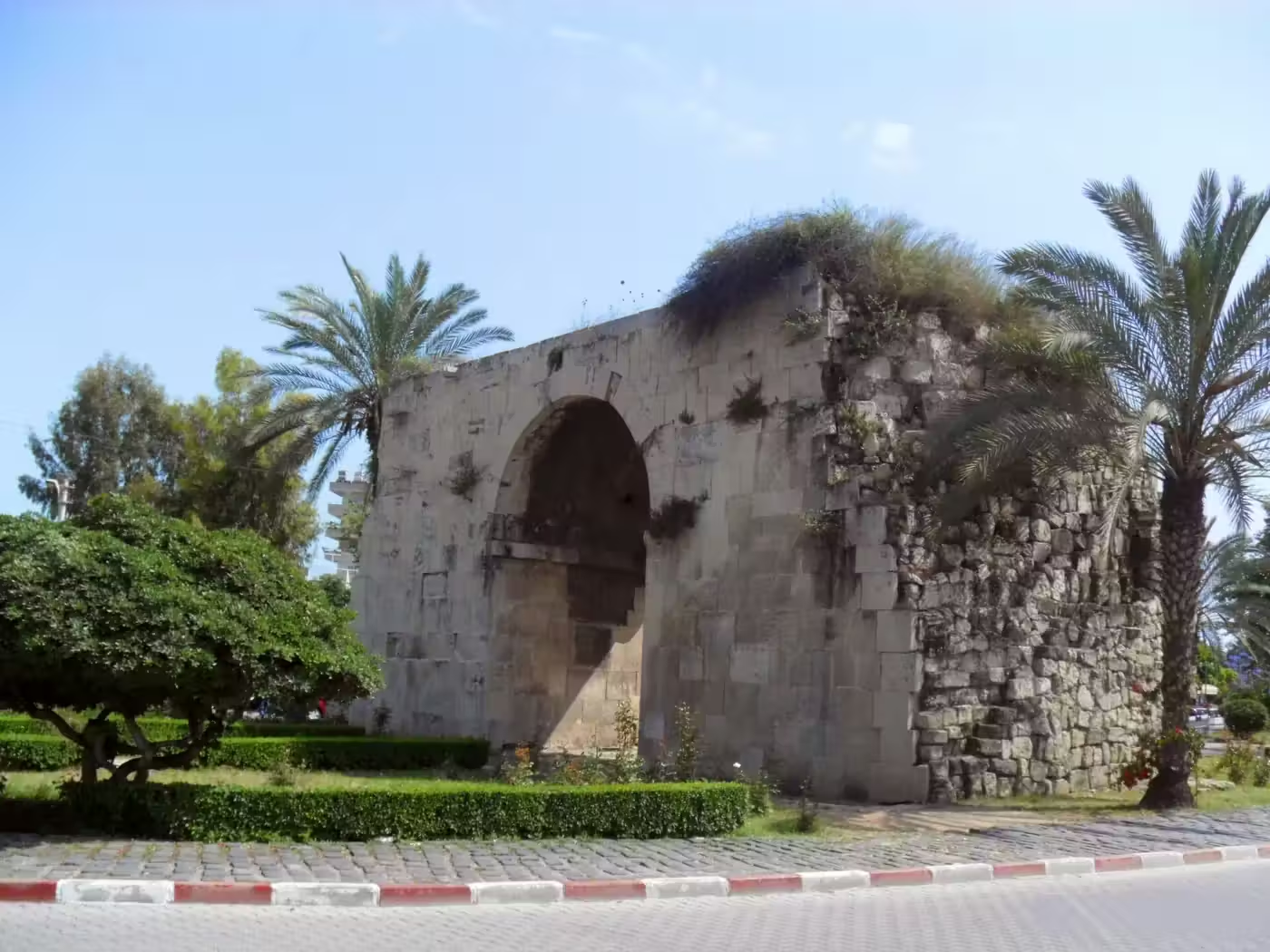
Of Paul’s family the sources say little that can be trusted; of the city that formed him they say a great deal. Tarsus was an important cultural center in southeastern Anatolia.1 More than 300 years before Paul it was already the leading city of the region,2 with a strategic trading port on the eastern Mediterranean.3
It was known as the birthplace of many prominent philosophers and was home to a large Diaspora Jewish community. That community had supported Roman military campaigns against piracy and Parthian attack, and Julius Caesar rewarded it with Roman citizenship, a privilege rarely granted and greatly prized.4
After finishing his studies Saul returned to Tarsus to help his father as a merchant, and at the same time worked to spread Pharisee Judaism among his own people. The Pharisee school was the strongest opponent of the mission of ʿĪsā al-Masīḥ at the time.
Saul hoped that the new teaching would weaken for want of a following. The opposite happened. The teaching of ʿĪsā al-Masīḥ, spread by his followers under Peter, one of his most faithful disciples, grew by the day.
Saul seemed close to despair, yet the intention to divert what the faithful followers were preaching remained fixed in him. What may have occurred to him at that point was to destroy the teaching of ʿĪsā ibn Maryam from within.5
To persuade the followers of ʿĪsā ibn Maryam to accept him, Saul had to show proof that he had received a message directly from ʿĪsā ibn Maryam, so that he could be appointed one of his legitimate followers. That is the way he could carry out his subversion from the inside.
A persona for every audience
One feature that raises doubt in any critical reading of Paul is the shifting, layered way he declares his identity in Acts. To the crowd he is “a Jew of Tarsus.”6
To the centurion he is “a Roman.”7 Before the Sanhedrin he is “a Pharisee, the son of a Pharisee.”8
These statements do not formally contradict one another. The inconsistency in how and when he deploys them points to an opportunistic shaping of self-image that changes with the audience. In the terms of modern rhetoric, Paul presents a persona multiplex, a figure who adopts several faces of identity strategically to reach a particular goal.
In one of his letters Paul admits as much: that he was ready to adapt himself to anyone, to be like a Jew among Jews and like a Gentile among Gentiles, to gain influence over them.
19Ἐλεύθερος γὰρ ὢν ἐκ πάντων πᾶσιν ἐμαυτὸν ἐδούλωσα, ἵνα τοὺς πλείονας κερδήσω· 20καὶ ἐγενόμην τοῖς Ἰουδαίοις ὡς Ἰουδαῖος, ἵνα Ἰουδαίους κερδήσω· τοῖς ὑπὸ νόμον ὡς ὑπὸ νόμον, μὴ ὢν αὐτὸς ὑπὸ νόμον, ἵνα τοὺς ὑπὸ νόμον κερδήσω· 21τοῖς ἀνόμοις ὡς ἄνομος, μὴ ὢν ἄνομος θεοῦ ἀλλʼ ἔννομος Χριστοῦ, ἵνα κερδάνω τοὺς ἀνόμους· 22ἐγενόμην τοῖς ἀσθενέσιν ἀσθενής, ἵνα τοὺς ἀσθενεῖς κερδήσω· τοῖς πᾶσιν γέγονα πάντα, ἵνα πάντως τινὰς σώσω.
19For though I be free from all men, yet have I made myself servant unto all, that I might gain the more. 20And unto the Jews I became as a Jew, that I might gain the Jews; to them that are under the law, as under the law, that I might gain them that are under the law; 21To them that are without law, as without law, (being not without law to God, but under the law to Christ,) that I might gain them that are without law. 22To the weak became I as weak, that I might gain the weak: I am made all things to all men, that I might by all means save some.9
If a preacher is willing to be “all things to all men,” the real foundation of belief has been sacrificed for acceptance and convenience. The ḥawāriyyūn (الحواريون, “the disciples”) preached on the basis of a fixed truth grounded in revelation.
Paul spread his message through a fabricated image and adaptation to context. His changing identity is therefore more than variation: it is a systematic misdirection that obscures the authenticity of the message of ʿĪsā ibn Maryam ʿalayhi al-salām, peace be upon him.
- Tarsus was also the capital of Cilicia in Anatolia at the time. ↩
- G. Ernest Wright, Great People of the Bible and How They Lived (Pleasantville, NY: Reader’s Digest Association, 1974). ↩
- George T. Montague, The Living Thought of St. Paul (Milwaukee: Bruce Publishing, 1966). ↩
- N. T. Wright, Paul and the Faithfulness of God (Minneapolis: Fortress Press, 2013). ↩
- See the incident at Galatians 2:11–14. ↩
- Acts 21:39. ↩
- Acts 22:25. ↩
- Acts 23:6. ↩
- 1 Corinthians 9:19–22 (SBLGNT; KJV). ↩