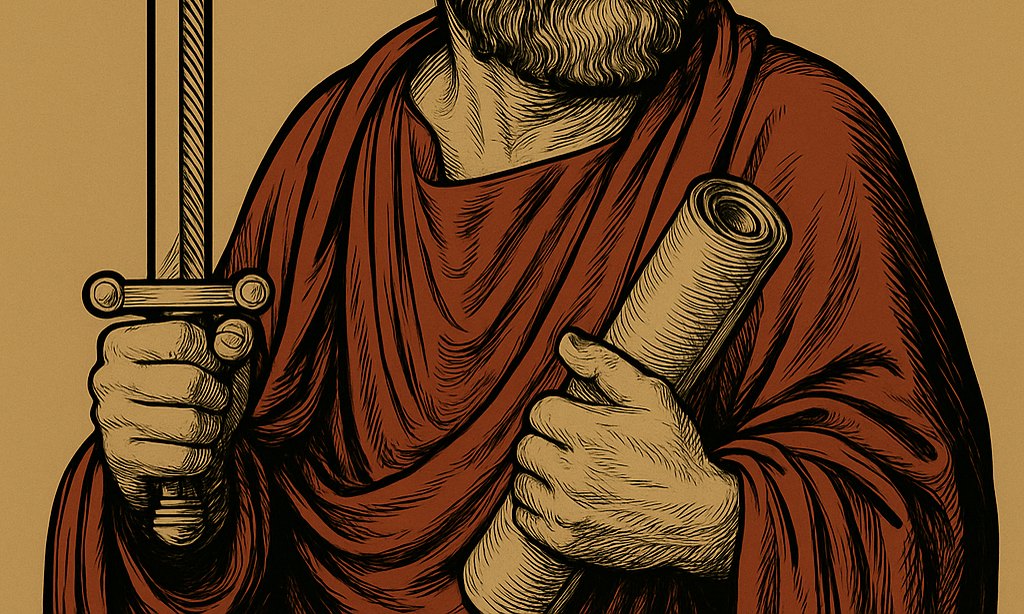
One thing that casts doubt on Paul’s claim to apostleship by personal revelation is the content of his letters: personal matters, logistics and trivial notes, which is unusual for a man who receives revelation directly. A message claimed as divine teaching should hold moral principles or universal guidance for life. The content of Paul’s letters shows the opposite.
Wine, cloaks and parchments
Paul advises Timothy to take a little wine for his stomach:
23Drink no longer water, but use a little wine for thy stomach’s sake and thine often infirmities.1
Content of this kind is personal health advice, trivial beside what a scripture ought to contain. In 2 Timothy Paul writes:
13The cloke that I left at Troas with Carpus, when thou comest, bring with thee, and the books, but especially the parchments.2
This is neither revelation nor spiritual guidance. It is a request to bring clothing and reading matter, the stuff of private correspondence. In the same letter Paul reports that he left Trophimus sick at Miletus,6 a statement that carries no spiritual value and raises a question about the claim that he possessed healing powers of the kind described elsewhere.
He mentions his plan to winter at Nicopolis and asks that provision be made for Zenas and Apollos.7 Again, nothing of spiritual worth.
The letter to Philemon is wholly taken up with a personal matter involving a slave named Onesimus, without any exposition of faith or guidance for worship.8 The letter to the Romans carries a long list of greetings to particular individuals, closer to the close of a social letter than to anything else.9
Such material is prima facie evidence of a private correspondence. Its content is worldly, tied to personal needs, and it fails to match the character of an apostle receiving revelation directly. Read plainly, the style and content of these letters differ little from a diary or from today’s private messages, a WhatsApp text, a Facebook status, a social-media post, full of stomachs, clothing, winter quarters, lists of acquaintances and errands.
In form and style these letters differ sharply from the revelations of the earlier prophets, which typically open with “Thus saith the LORD” and carry moral summons and divine warning. The letter of James and 1 Peter, for instance, address a general community and are full of moral teaching and spiritual exhortation. Paul’s letters tend to focus on individuals and small matters, which makes them read as personal notes.
Set them beside the words of ʿĪsā ibn Maryam (ʿalayhi al-salām, peace be upon him): “Blessed are the poor in spirit,”10 or “Love your enemies,”11 and the difference in approach is plain. ʿĪsā ibn Maryam never gave instructions to fetch a forgotten item or offered health advice such as drinking wine. Paul’s writing is built on personal experience and worldly need, and it reads like daily social messaging.
A ledger of sufferings
In his second letter to the Corinthians, Paul lists the sufferings he has endured to prove his superiority as an apostle of Christ Jesus.12
23Are they ministers of Christ? (I speak as a fool) I am more; in labours more abundant, in stripes above measure, in prisons more frequent, in deaths oft. 24Of the Jews five times received I forty stripes save one. 25Thrice was I beaten with rods, once was I stoned, thrice I suffered shipwreck, a night and a day I have been in the deep; 26In journeyings often, in perils of waters, in perils of robbers, in perils by mine own countrymen, in perils by the heathen, in perils in the city, in perils in the wilderness, in perils in the sea, in perils among false brethren; 27In weariness and painfulness, in watchings often, in hunger and thirst, in fastings often, in cold and nakedness.3
The passage fails to persuade on content, and it exposes the weakness of his rhetoric and his tendency to excessive self-glorification. Claims such as “in labours more abundant, in stripes above measure, in prisons more frequent” are hyperbole that adds nothing to a theological or moral system. It reads as propaganda to cover a want of basic legitimacy in his standing as a religious figure.
The disciples never itemized their trials; a fortiori, a man who claims to have learned contentment in every state had no cause to. Paul made his catalog of sufferings a tool for rivaling and outdoing the authority of the other disciples.13
Some may say the list serves to encourage congregations under persecution. That argument leaves unanswered the basic contradiction between the rhetoric of endurance in Philippians and the complaining, exaggerated tone of 2 Corinthians. There is no ethical continuity between a man who claims to be “content in whatsoever state” and one who in the same breath itemizes every wound and hardship at length.
Paul himself admits, “I speak as a fool,”14 as if aware that his rhetoric was straying from the humility he ought to teach. The argument that the account is motivational is a rationalization that covers a deep inconsistency of principle in his writing.
A style of this kind reflects a need to be believed and recognized, something often associated with people short of self-confidence or trying to build a false heroic image. Paul’s claim of “faith in Christ”15 becomes an empty phrase used to justify his ego. Though Paul tries to convey extraordinary martyrdom and endurance through the list, it loses its force once one realizes that no independent party can confirm the claims.
No historical record supports the actual number of beatings, imprisonments or threats to his life that he asserts. Did all this happen, or was it invented for rhetorical effect?
Paul’s claims in this letter should be read as an effort to build his own legitimacy, and never as proof of authentic spiritual sacrifice. They recall a satirical scene in the classic film Pendekar Bujang Lapok, in which the antagonist, Tauke Sampan, produces an inflated and absurd bill:
One boat lost, 100 ringgit. Two boats drifted away, 200 ringgit. Rental money for the lost boat, 300 ringgit. Medicine for the people who fainted, 50 ringgit 50 sen. Medicine for eight people with swellings, 73 ringgit 71 sen. Total, 724 ringgit 71 sen. Payment demanded now!16
The scene shows an unreasonable, long-winded financial claim by an antagonist who tries to manipulate the situation with an implausible dramatic account. So too Paul, who uses his list of sufferings as a tool to strengthen his influence in the early church. Anyone who wants to judge a man’s honesty should not be taken in by an inflated list.
The saying “if you fear the risk, do not talk of the struggle” fits those who boast and parade their “sacrifices” without valid ground. Paul set himself up as a religious warrior, but the weakness of his narrative shows him closer to a comic character from the Jalan Ampas studio than to a true martyr.
The Greek body and the Jewish bed
Paul’s immersion in Greek culture and philosophy (Hellenism) and in Stoicism, which saw nature as divine, made it easier for him to draw the people of the time into the new religion he brought. Some of these schools rejected the desires of the body and made restraint of appetite the mark of spiritual purity.17 The dualism of spirit (πνεῦμα, pneuma) and body (σάρξ, sarx) was the basis of Greek thought, in which the body was the source of weakness and sin while the spirit was pure and noble.
Small wonder that Paul inherited the tendency. He states plainly that “it is good for a man not to touch a woman.”
He repeats it in verse 7, where he regards celibacy as the better, even the ideal state. Yet in the same passage he advises every man to have his own wife to avoid fornication.18
1Now concerning the things whereof ye wrote unto me: It is good for a man not to touch a woman. 2Nevertheless, to avoid fornication, let every man have his own wife, and let every woman have her own husband.4
The contradiction raises a question: is marriage a good to be encouraged, or a compromise to avoid sin? The ambiguity shows an ethical confusion in Paul’s teaching on marriage and sex. Sexual desire is treated as a weakness to be avoided altogether, and never as part of human nature to be governed responsibly.19
Paul also defended his right to take a wife like the other apostles,20 although he rejected marriage as a personal choice.21 That adds to the confusion: on one side he distrusts marriage as a hindrance to full devotion to God,22 on the other he acknowledges the institution as a right and a practice of the disciples.
The mixed attitude reveals an inner tension between the ascetic impulse and real social need. A teaching of this kind is foreign to every earlier moral and ethical tradition, and it reflects a deep discomfort with the body and with human desire.
Paul’s view runs directly against the Talmudic tradition, which recognizes marriage and intimacy as a sacred duty and a source of happiness. In the Talmud, marital relations are an obligation to be fulfilled with responsibility and love.
The tragic story of R. Rehumi, who neglected his wife in pursuit of learning until it led to his death,23 stresses the importance of tending the marriage. The saying that “a woman prefers one kab24 with gaiety to ten kab with abstinence” asserts the priority of domestic happiness over a life hemmed in by restriction or the denial of pleasure.
The Talmudic tradition goes further and gives priority to the duties of family and offspring. Even a man who has fulfilled the commandment to be fruitful should not live without a wife.25
The tradition also condemns vows that keep husband and wife apart, as something that can destroy the harmony of the home.26 In the Jewish view intimacy is a natural part of life, to be governed wisely and responsibly.
The thorn in the flesh
Paul describes himself as one “given a thorn in the flesh” (σκόλοψ τῇ σαρκί, skólops tē sarki),27 a mysterious phrase much interpreted by scholars. Some connect it with physical illness; others read it as a figure for uncontrolled desire. If it refers to sexual desire, that would explain Paul’s insistence on celibacy as the way out.
7And lest I should be exalted above measure through the abundance of the revelations, there was given to me a thorn in the flesh, the messenger of Satan to buffet me, lest I should be exalted above measure. 8For this thing I besought the Lord thrice, that it might depart from me. 9And he said unto me, My grace is sufficient for thee: for my strength is made perfect in weakness. Most gladly therefore will I rather glory in my infirmities, that the power of Christ may rest upon me.5
A more detailed clinical hypothesis comes from Antonio Pascual, Anna Manresa Lamarca and Josep Piquero Casals, who propose that the phrase refers to a chronic skin disease, painful and socially repellent. On dermatological and historical grounds they suggest that Paul may have suffered from lupus, dermatomyositis or nodular vasculitis, diseases that bear directly on body image and social interaction, so that the suffering was both outward and psychological.28 That reading also opens the possibility that the physical suffering aggravated an existing inner conflict, including a struggle against the urges of the body.
Paul’s own statements support it: bodily weakness, continual suffering, and a disease he saw as an affliction from Satan (ἄγγελος Σατανᾶ). In his letters Paul often presents the body as the source of weakness and sin.
He ties bodily desire to “the flesh,” which he sets against “the spirit.”29 For Paul, the superior spiritual life demands total mastery of bodily impulse, a dualism drawn from Hellenistic philosophy, in which the body is the prison of the soul.
Some modern scholars have raised the possibility that Paul’s attitude sprang from unresolved sexual conflict or repressed sexual desires never consciously addressed. His extreme severity toward sexual relations and the founding of families, and his failure to acknowledge the place of physical love in religious life, raise questions about the psychological background and the real orientation that may have lain hidden.30
His act of circumcising Timothy with his own hands31 only deepens the strange shadow over his orientation and motives. A grown man circumcising a young man for political reasons is no neutral act, above all when done by a figure who rejected the law and yet chose to carry it out himself. Within a teaching so full of hostility to sex, the body and women, the incident gives a faint signal of a dark side of Paul rarely discussed openly: an inner doubt about his own identity, perhaps too deep to admit consciously.
Paul’s contempt for intimacy and his elevation of celibacy as a higher form of spirituality reflect an inner conflict. Behind the spiritual idealism he tried to defend lay fear and rejection of bodily desire, which he regarded as a threat to purity.
If so, the ideology of celibacy inherited from Paul’s teaching reflects an unbalanced personal experience. From it grew a theology of the body that distrusts desire, and from that the institutions of the celibate priesthood and monasticism, a spirituality founded on rejection of the human body.32
These doctrines then became the principal foundation of Christian teaching down to the present day.
- 1 Timothy 5:23 (KJV). ↩
- 2 Timothy 4:13 (KJV). ↩
- 2 Corinthians 11:23–27 (KJV). ↩
- 1 Corinthians 7:1–2 (KJV). ↩
- 2 Corinthians 12:7–9 (KJV). ↩
- See 2 Timothy 4:20. ↩
- See Titus 3:12–13. ↩
- Philemon 1:10–12. ↩
- Romans 16:3–15. ↩
- See Matthew 5:3. ↩
- See Matthew 5:44. ↩
- See 2 Corinthians 11:23–29. ↩
- See Philippians 4:11–13, where Paul claims to have “learned, in whatsoever state I am, therewith to be content.” The statement sits oddly with the tone of 2 Corinthians 11:21–23, which parades his sufferings in detail. Although in 1 Corinthians 1:31 and 4:7 he condemns self-praise, in this list he makes suffering the capital of a claim to apostolic superiority. The inconsistency shows a weakness of ethical consistency in the principles he tried to convey. ↩
- 2 Corinthians 11:23. ↩
- See Galatians 2:16; Philippians 3:9; Romans 3:22. ↩
- Pendekar Bujang Lapok, directed by P. Ramlee (Malay Film Productions, distributed by Shaw Brothers, 1959). See also Nur Afifah Vanitha Abdullah and Intan Zainatul Maria Zainudin, “Aspek sosiologi filem Pendekar Bujang Lapok (1959),” Jurnal Melayu, special issue, December 2021, pp. 487–504. The lines are given here in the author’s translation. ↩
- See John Dillon, The Middle Platonists: 80 B.C. to A.D. 220 (Ithaca: Cornell University Press, 1996); and Troels Engberg-Pedersen, Paul and the Stoics (Edinburgh: T&T Clark, 2000). ↩
- 1 Corinthians 7:9. ↩
- See James D. G. Dunn, The Theology of Paul the Apostle (Grand Rapids: Eerdmans, 1998). ↩
- 1 Corinthians 9:5. ↩
- 1 Corinthians 7:6–7. ↩
- 1 Corinthians 7:32–34. ↩
- See Kethuboth 62b. ↩
- The kab (קַב) is an ancient unit of volume in the Jewish system of measures, about 1.2 to 1.3 liters, used chiefly for dry goods in Talmudic tradition. ↩
- Yevamoth 63b. ↩
- Nedarim 82a. ↩
- 2 Corinthians 12:7. ↩
- See Pascual et al., “Saint Paul’s Thorn in the Flesh: A Dermatological Weakness?,” Acta Medico-Historica Adriatica, vol. 20, no. 1 (2022), pp. 83–98. ↩
- See Galatians 5:17; Romans 8:5–8. ↩
- See Bart D. Ehrman, Peter, Paul and Mary Magdalene: The Followers of Jesus in History and Legend (New York: Oxford University Press, 2006); also Troels Engberg-Pedersen, op. cit. ↩
- Acts 16:3. ↩
- Walter Burkert, Ancient Mystery Cults (Cambridge: Harvard University Press, 1987). ↩