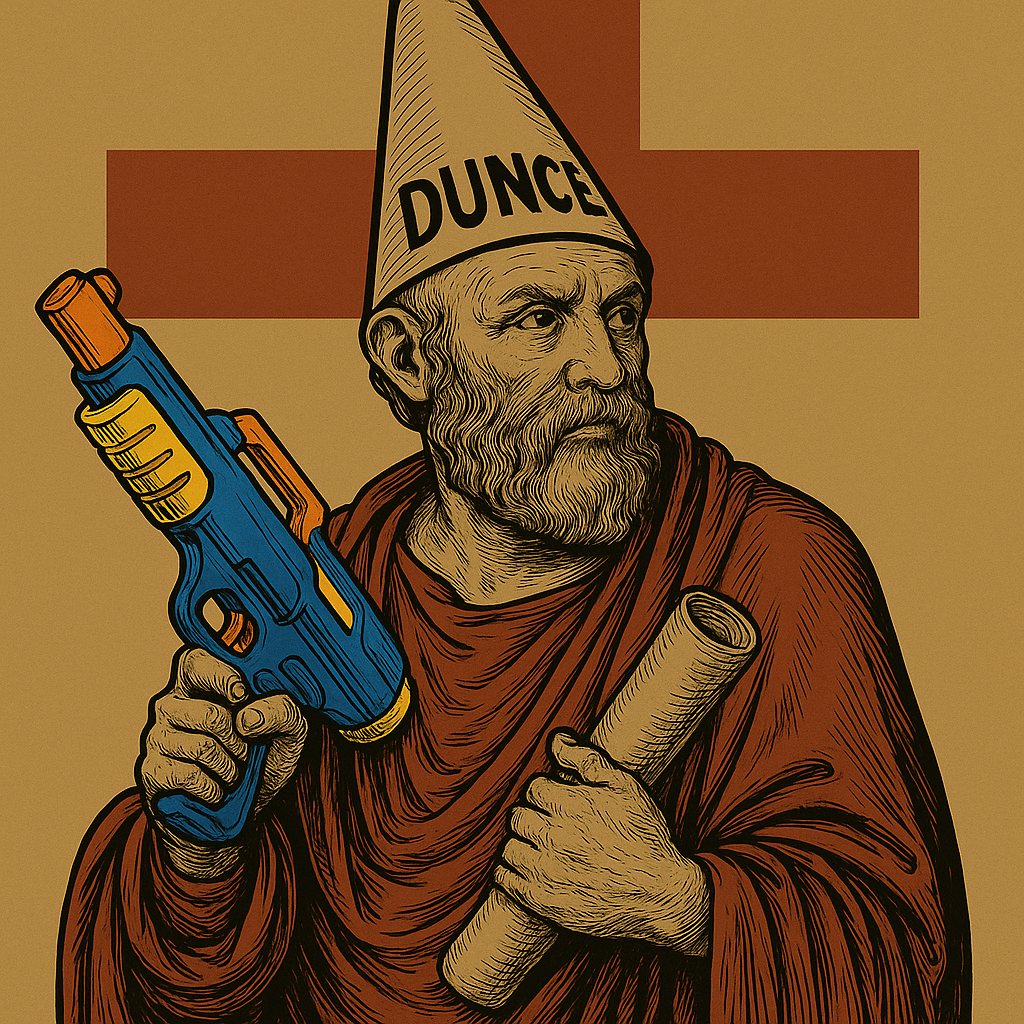
Rejection of Paul came from the disciples and the early movements such as the Ebionites, and also from influential figures in the history of Western thought. Among the most prominent was Thomas Jefferson (1743–1826), third President of the United States and one of that nation’s founding fathers. In his effort to purify the moral teaching of ʿĪsā ibn Maryam (ʿalayhi al-salām, peace be upon him) from church and mythological elements, Jefferson compiled a special text titled The Life and Morals of Jesus of Nazareth, later known as the Jefferson Bible.4
In it he deliberately removed every element of miracle and divinity and, most significantly, every writing of Paul. For Jefferson, Paul was the figure who had distorted the original message of ʿĪsā ibn Maryam.5
Jefferson’s step reflects an early awareness among Western thinkers that the Christianity inherited from the church is a construction by post-apostolic figures such as Paul, and no true representation of the teaching of Jesus. For Jefferson and other figures of the Enlightenment, Paul’s influence was the chief cause of the transformation of the religion of Jesus into a religion about Jesus, a shift heavy with metaphysical implications and institutional power. The presence of such voices within the Western tradition itself strengthens the argument that Paul is the founder of a new religious ideology, one that has long raised doubt among those who judge his sources honestly.
A prophecy that failed
Ironically, the founder of the new teaching that dominates church theology ended his life in a scene unlike the noble picture of a heavenly messenger. The Bible itself refutes Paul’s claim to be one of the disciples. Consider the following verse:
16For the Lord himself shall descend from heaven with a shout, with the voice of the archangel, and with the trump of God: and the dead in Christ shall rise first: 17Then we which are alive and remain shall be caught up together with them in the clouds, to meet the Lord in the air: and so shall we ever be with the Lord.1
Paul’s prediction plainly states that he and the Christians still alive at the time would be taken up by the Lord (Jesus Christ) and go together to meet him.6 That is more than spiritual hope.
It is a form of prophecy written in the name of “the word of the Lord.” New Testament scholars such as Bart D. Ehrman7 and Albert Schweitzer8 acknowledge that Paul expected the parousia (παρουσία), a Greek term meaning “coming” or “presence” that refers to the reappearance of Christ in the apocalyptic tradition, within his own generation.
That is not what happened. What happened instead was the sword that “took him up” and parted his head from his body in the reign of Nero, around 64 to 68 CE.9
By the standard the Torah itself sets, a prophet who speaks in the name of the LORD, and the thing does not come to pass, has spoken presumptuously, and is not to be feared:
22When a prophet speaketh in the name of the LORD, if the thing follow not, nor come to pass, that is the thing which the LORD hath not spoken, but the prophet hath spoken it presumptuously: thou shalt not be afraid of him.2
Textually and ethically, then, Paul meets the criterion of a false prophet, for delivering in the name of God a prediction that did not come true.
A death the scriptures never record
Paul died as a state criminal, sentenced by the imperial power regarded as the enemy of the movement he supposedly represented. The fact that Paul was executed by the Roman regime, the same regime that according to church doctrine also killed Jesus, raises serious questions about the legitimacy of his “apostleship”. His death is recorded in no book of the New Testament, including Acts, which consistently documents Paul’s travels and apostolic activity and then breaks off abruptly while he is still under house arrest in Rome.10
More puzzling still, the absence of any narrative of revelation or spiritual witness about the death of Paul, so dominant a figure in the building of Christian doctrine, is an extraordinary silence. If he was the “apostle to the Gentiles,” why is there no record of his end in the sacred text?
Why does the story of his death exist only in secondary church writings that appeared decades later,11 without witness or revelation? The death of Paul as a state criminal, passed over in silence by the canonical texts, raises a serious theological doubt: is this the end of a messenger of God, or of a religious figure shaped by politics, confirmed by the church, and abandoned by revelation?
Although no book of the New Testament, Acts included, records the last moments of Paul’s life, various secondary church writings built a narrative of his death. In 1 Clement, the letter written by Clement of Rome around 90 CE, there is this note on Paul:
By reason of jealousy and strife Paul by his example pointed out the prize of patient endurance. After that he had been seven times in bonds, had been driven into exile, had been stoned, had preached in the East and in the West, he won the noble renown which was the reward of his faith, having taught righteousness unto the whole world and having reached the farthest bounds of the West; and when he had borne his testimony before the rulers, so he departed from the world and went unto the holy place, having been found a notable pattern of patient endurance.12
The text leaves unstated that Paul died in Rome, and unstated that he died a martyr. That interpretation was first given by modern scholars such as Raymond Brown, on the strength of vague phrases like “the farthest bounds of the West” and “went unto the holy place.”13
Three centuries later Eusebius of Caesarea wrote in his Ecclesiastical History that they, Peter and Paul, “suffered martyrdom at that time … Paul was beheaded in Rome, and Peter crucified.”14 The tradition was later reinforced through church liturgy, above all the Feast of Saints Peter and Paul on 29 June. The traditional site of Paul’s execution is supposedly the church of San Paolo alle Tre Fontane, and the great basilica of Saint Paul Outside the Walls was built over what is said to be the place of his burial.
Later versions circulating in Greek, Latin and Syriac give a picture more symbolic than historical. In one version, when Paul was beheaded milk spurted from his neck in place of blood, a symbol of purity that rests on no historical fact and was shaped to stress his holy status and spiritual confirmation.15 The narrative also mentions a woman named Lucina who took Paul’s body and buried it on her land on the Via Ostiensis, laying the basis for the liturgical rites and the veneration of a particular place in Rome as a site of pilgrimage.16
Allegorical elements of this kind show how Paul’s death was reinterpreted through the theological frame of the church . They reflect an effort to shape an ex post sanctity, setting Paul’s death within a sacred mythology aligned with the ideological needs of the church.
All this information derives from no revelation and exists in no canonical book. It rests only on oral tradition, on apocryphal texts such as the Acts of Paul and the Acts of Peter, and on free interpretation of 2 Timothy 4:13, which says only that Paul left a cloak at Troas, with no indication of death.17
More puzzling still, the Catholic Church claims that Paul’s skull is now in the Lateran Basilica, beside the skull of Peter. In 665 CE Pope Vitalian is said to have sent several relics of Paul to Britain, to King Oswy.18 All this only adds to the obscurity of one important question: if Paul was the great apostle the church claims, why is the story of his death nowhere mentioned in the sacred texts?
Eutychus
Before everything ends, Acts leaves us with one moment hard to forget, for its tedium:
9And there sat in a window a certain young man named Eutychus, being fallen into a deep sleep: and as Paul was long preaching, he sunk down with sleep, and fell down from the third loft, and was taken up dead.3
Is this the face of an “apostle” at the end of the age? In the middle of preaching supposedly sourced in revelation, Paul’s sermon was long and dull enough to kill a listener. No prophecy, no charisma, no resurrection.
Only a young listener too weary to go on living. If that is no anticlimax, what is?
The argument that Paul’s death proves the truth of his message is a non sequitur. Many figures in history, founders of heresies, political figures, even cult leaders, have died for their own beliefs.
Dying for a conviction shows the depth of commitment, and nothing more. With no confirmed revelation, no witness of the community and no recognition in the sacred text, Paul’s death, however sincere in intention, cannot raise him to the rank of apostle.
What Paul went through left its mark on his personality, and it also shaped the pattern of the teaching he brought, a teaching born of the rationalization of his own inner crisis, and never of the continuity of revelation. The emotional conflict evident in his letters, above all the swing between remorse and self-justification, suggests that the dogma he introduced was more than a theological system.
It was the reflection of a soul struggling with guilt and the need to justify its past. Small wonder that the frame of faith he built is full of paradox and inner tension, from the question of the Torah to the concept of redemption, all centered on a narrative that tries to heal, or at least to cover, a psychological wound that never healed.
- 1 Thessalonians 4:16–17 (KJV). ↩
- Deuteronomy 18:22 (KJV). ↩
- Acts 20:9 (KJV). ↩
- Thomas Jefferson, The Life and Morals of Jesus of Nazareth (Washington: Government Printing Office, 1904). ↩
- Edwin S. Gaustad, Sworn on the Altar of God: A Religious Biography of Thomas Jefferson (Grand Rapids: Eerdmans, 1996), pp. 119–121. ↩
- 1 Corinthians 7:29. ↩
- See Bart D. Ehrman, Jesus: Apocalyptic Prophet of the New Millennium (Oxford: Oxford University Press, 1999), pp. 130ff. ↩
- See Albert Schweitzer, The Mystery of the Kingdom of God: The Secret of Jesus’ Messiahship and Passion (Amherst, NY: Prometheus Books, 2001), pp. 21ff. Schweitzer states that Paul and his followers believed the second coming of Christ would occur within their lifetime, and that Paul’s death under Nero ended that hope. ↩
- See “Saint Paul,” FreeArt Gallery, https://bit.ly/43dM9gq (accessed 18 December 2024); “Saint Paul, Apostle to the Gentiles,” St. Paul’s Greek Orthodox Church, https://bit.ly/4dAC00U (accessed 18 December 2024); and “St. Paul,” Catholic Encyclopedia, https://bit.ly/4kfwumU (accessed 18 December 2024). ↩
- Acts 28:30–31. See also F. F. Bruce, The Acts of the Apostles: The Greek Text with Introduction and Commentary (Grand Rapids: Eerdmans, 1990), p. 517. Bruce notes that Acts ends abruptly without explaining Paul’s final fate. ↩
- See Eusebius, Ecclesiastical History II.25; cf. Jerome, De Viris Illustribus 5 and Tertullian, Scorpiace 15. ↩
- J. B. Lightfoot, The Apostolic Fathers: Part I. Clement, Ignatius and Polycarp (London: Macmillan, 1890), p. 274. See 1 Clement 5:5–6. ↩
- Raymond E. Brown and John P. Meier, Antioch and Rome: New Testament Cradles of Catholic Christianity (New York: Paulist Press, 1983), p. 124. ↩
- Eusebius of Caesarea, Ecclesiastical History II.25, ed. Philip Schaff (Grand Rapids: Christian Classics Ethereal Library, 1994), p. 118. Rendered here from the Malay edition of the book. ↩
- See David L. Eastman, The Ancient Martyrdom Accounts of Peter and Paul (Atlanta: SBL Press, 2015), p. 91. In the Syriac version, when Paul is beheaded, milk rather than blood flows from his neck as a sign of purity, a post-revelatory symbolism. ↩
- ibid., pp. 91–92. ↩
- The Acts of Paul and the Acts of Peter are second-century apocryphal texts. 2 Timothy 4:13 reads: “The cloke that I left at Troas with Carpus, when thou comest, bring with thee, and the books, but especially the parchments.” ↩
- H. Syer Cuming, “Notes on a Group of Reliquaries,” Journal of the British Archaeological Association, vol. 26, no. 4 (1870), pp. 271–280. ↩